



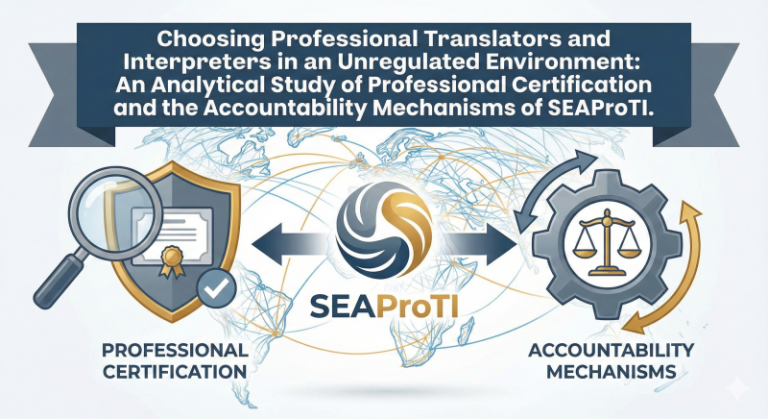
Choosing Professional Translators and Interpreters in an Unregulated Environment:
An Analytical Study of Professional Certification and the Accountability Mechanisms of SEAProTI
8 January 2026, Bangkok—In Thailand and across Southeast Asia, the professions of translation and interpreting continue to operate in a largely unregulated environment. As a result, individuals may present themselves as translators or interpreters without undergoing competency assessment or adhering to professional ethical standards. This article analyses the structural risks posed to service users by the absence of regulatory oversight and examines the role of professional certification as a risk-mitigation mechanism. Particular attention is given to the role of the Southeast Asian Association of Professional Translators and Interpreters (SEAProTI) as a professional institution that promotes accountability, ethical conduct, and quality assurance in contexts where linguistic errors may have legal, medical, regulatory, or institutional consequences.
Keywords: translators and interpreters, professional certification, professional ethics, accountability, SEAProTI
Introduction: Structural Challenges in an Unregulated Profession
Translation and interpreting play a critical role in ensuring access to rights, justice, and informed decision-making. However, in many jurisdictions—including Thailand—the profession lacks a dedicated legal or regulatory framework. Consequently, there are no enforceable minimum standards governing qualifications, professional competence, or accountability.
This structural gap creates significant information asymmetry between service providers and clients. Clients are often unable to assess the true quality of translation or interpreting services in advance and may only become aware of deficiencies after tangible harm has occurred (Pym, 2014).
Risks Arising from the Absence of Professional Standards
In unregulated environments, linguistic proficiency alone is frequently—and incorrectly—assumed to be sufficient for professional practice. In reality, translation and interpreting in high-risk domains such as law, healthcare, and public administration require specialised knowledge, ethical awareness, and an understanding of the real-world consequences of linguistic choices.
Research in institutional and legal interpreting demonstrates that linguistic errors can lead to violations of rights, flawed decision-making, and damage to institutional credibility (Hale, 2007; Mikkelson, 2016).
Professional Certification as a Risk-Mitigation Mechanism
Where statutory regulation is absent, professional certification functions as a form of social regulation. Certification systems assess competence, establish ethical obligations, and create accountability structures that protect service users.
Certified translators and recognized translation certification providers undergo independent assessment and commit to a Code of Professional Conduct. This commitment typically encompasses accuracy, completeness, confidentiality, impartiality, and professional responsibility for the outcomes of their work.
The Role of SEAProTI as a Professional Institution
SEAProTI operates as a professional institution that establishes standards in contexts where state regulation remains limited. Its role is not to confer legal authority comparable to that of a government body, but to clearly identify who has been professionally assessed and who accepts responsibility for their work.
The SEAProTI Directory functions as an institutional reference point for clients, courts, hospitals, government agencies, and international organisations seeking to verify professional competence and ethical accountability among language service providers.
Choosing SEAProTI within a Risk-Management Framework
In settings where linguistic errors carry high costs, the decision to engage certified translators or interpreters is not merely a matter of preference or convenience. It is an exercise in risk management.
SEAProTI mitigates professional risk through:
- prior assessment of competence,
- binding ethical obligations,
- clearly defined professional accountability, and
- a transparent and verifiable reference system for service users.
Conclusion
This article demonstrates that in jurisdictions where translation and interpreting remain unregulated, professional certification bodies such as SEAProTI play a vital role in protecting service users and advancing professional standards. Choosing a certified professional is not simply about selecting someone who can translate or interpret, but about selecting someone who is accountable for the consequences of their work.
Where outcomes matter, verifiable competence and professional responsibility are essential.
References
- Hale, S. B. (2007). Community interpreting. Palgrave Macmillan.
- Mikkelson, H. (2016). Introduction to court interpreting (2nd ed.). Routledge.
- Pym, A. (2014). Exploring translation theories (2nd ed.). Routledge.
- Southeast Asian Association of Professional Translators and Interpreters. (2024). Code of Professional Conduct. SEAProTI.
About Certified Translators, Translation Certifiers, and Certified Interpreters of SEAProTI
The Southeast Asian Association of Professional Translators and Interpreters (SEAProTI) has formally announced the qualifications and requirements for registration of Certified Translators, Translation Certification Providers, and Certified Interpreters in Sections 9 and 10 of the Royal Gazette, published by the Secretariat of the Cabinet, Office of the Prime Minister of Thailand, on 25 July 2024 (Vol. 141, Part 66 Ng, p. 100). Certified Translators, Translation Certification Providers, and Certified Interpreters
The Council of State has proposed the enactment of a Royal Decree, granting registered translators and recognised translation certifiers from professional associations or accredited language institutions the authority to provide legally valid translation certification (Letter to SEAProTI dated April 28, 2025)
SEAProTI is the first professional association in Thailand and Southeast Asia to implement a comprehensive certification system for translators, certifiers, and interpreters.
Head Office: Baan Ratchakru Building, No. 33, Room 402, Soi Phahonyothin 5, Phahonyothin Road, Phaya Thai District, Bangkok 10400, Thailand
Email: hello@seaproti.com | Tel.: (+66) 2-114-3128 (Office hours: Mon–Fri, 09:00–17:00)
การเลือกใช้บริการนักแปลและล่ามมืออาชีพในบริบทที่ไร้การกำกับดูแล:
บทวิเคราะห์บทบาทของการรับรองวิชาชีพและกลไกความรับผิดชอบของ SEAProTI
8 มกราคม 2568, กรุงเทพมหานคร – ในประเทศไทยและภูมิภาคเอเชียตะวันออกเฉียงใต้ อาชีพนักแปลและล่ามยังคงดำรงอยู่ในสภาพที่ขาดการกำกับดูแลทางกฎหมายอย่างเป็นระบบ ส่งผลให้บุคคลทั่วไปสามารถประกอบอาชีพดังกล่าวได้โดยไม่จำเป็นต้องผ่านการประเมินสมรรถนะหรือยึดถือมาตรฐานทางจริยธรรม บทความนี้มุ่งวิเคราะห์ผลกระทบของภาวะไร้การกำกับดูแลต่อผู้ใช้บริการ และเสนอให้เห็นบทบาทของกลไกการรับรองวิชาชีพ โดยเฉพาะบทบาทของ Southeast Asian Association of Professional Translators and Interpreters (SEAProTI) ในฐานะสถาบันวิชาชีพที่ทำหน้าที่ลดความเสี่ยง สร้างความรับผิดชอบ และยกระดับมาตรฐานการให้บริการทางภาษาในบริบทที่ความผิดพลาดอาจก่อให้เกิดผลกระทบเชิงกฎหมาย การแพทย์ และสถาบัน
คำสำคัญ: นักแปลและล่าม, การรับรองวิชาชีพ, จริยธรรมวิชาชีพ, ความรับผิดชอบ, SEAProTI
บทนำ: ปัญหาเชิงโครงสร้างของวิชาชีพที่ไร้การกำกับดูแล
การแปลและการล่ามเป็นกิจกรรมที่มีบทบาทโดยตรงต่อการเข้าถึงสิทธิ ความยุติธรรม และการตัดสินใจเชิงนโยบาย อย่างไรก็ตาม ในหลายประเทศรวมถึงประเทศไทย อาชีพนักแปลและล่ามยังไม่ถูกกำกับดูแลโดยกฎหมายเฉพาะ ส่งผลให้ไม่มีเกณฑ์ขั้นต่ำที่บังคับใช้ได้ในด้านคุณสมบัติ ความสามารถ หรือความรับผิดชอบทางวิชาชีพ
ภาวะดังกล่าวก่อให้เกิด “ความไม่สมดุลของข้อมูล” (information asymmetry) ระหว่างผู้ให้บริการกับผู้ใช้บริการ โดยผู้ใช้ไม่สามารถประเมินคุณภาพที่แท้จริงของงานแปลหรือการล่ามได้ล่วงหน้า และมักจะทราบถึงความผิดพลาดเมื่อเกิดผลกระทบแล้ว (Pym, 2014)
ความเสี่ยงจากการใช้บริการที่ไร้มาตรฐาน
ในบริบทที่ไม่มีระบบกำกับดูแล ความสามารถทางภาษาเพียงอย่างเดียวมักถูกเข้าใจผิดว่าเพียงพอต่อการประกอบวิชาชีพ ทั้งที่ในความเป็นจริง งานแปลและล่ามในสาขากฎหมาย การแพทย์ หรือการกำกับดูแลทางรัฐ จำเป็นต้องอาศัยความรู้เชิงระบบ จริยธรรม และความเข้าใจผลกระทบของถ้อยคำ
งานวิจัยด้านการแปลเชิงสถาบันชี้ให้เห็นว่า ความผิดพลาดทางภาษาอาจนำไปสู่การละเมิดสิทธิ การตัดสินใจที่คลาดเคลื่อน หรือความเสียหายต่อความน่าเชื่อถือขององค์กร (Hale, 2007; Mikkelson, 2016)
การรับรองวิชาชีพในฐานะกลไกลดความเสี่ยง
ในสภาพที่กฎหมายยังไม่สามารถทำหน้าที่คัดกรองผู้ประกอบวิชาชีพได้ ระบบการรับรองโดยสถาบันวิชาชีพจึงทำหน้าที่เป็น “กลไกกำกับดูแลทางสังคม” (social regulation mechanism) โดยเน้นการประเมินสมรรถนะ ความรับผิดชอบ และจริยธรรม
นักแปลรับรอง (Certified Translators) และผู้รับรองการแปล (Translation Certification Providers) ต้องผ่านกระบวนการประเมินอิสระ และยอมรับการผูกพันตามจรรยาบรรณวิชาชีพ ซึ่งรวมถึงความถูกต้อง ความครบถ้วน ความเป็นกลาง การรักษาความลับ และความรับผิดชอบต่อผลลัพธ์ของงาน
บทบาทของ SEAProTI ในฐานะสถาบันวิชาชีพ
SEAProTI ทำหน้าที่เป็นสถาบันวิชาชีพที่สร้างมาตรฐานในบริบทที่รัฐยังไม่สามารถกำกับดูแลได้อย่างเป็นระบบ บทบาทสำคัญของ SEAProTI ไม่ได้อยู่ที่ “การอนุญาต” ในเชิงอำนาจรัฐ แต่คือการสร้างความชัดเจนว่า ใครคือผู้ประกอบวิชาชีพที่ผ่านการประเมิน และใครต้องรับผิดชอบต่อผลงานที่ตนส่งมอบ
SEAProTI Directory จึงทำหน้าที่เป็นจุดอ้างอิงเชิงโครงสร้าง (institutional reference point) สำหรับผู้ใช้บริการ หน่วยงานรัฐ ศาล โรงพยาบาล และองค์กรระหว่างประเทศ ในการตรวจสอบคุณสมบัติและความน่าเชื่อถือของผู้ให้บริการทางภาษา
การเลือกใช้ SEAProTI กับแนวคิดการบริหารความเสี่ยง
ในบริบทที่ความผิดพลาดทางภาษามีต้นทุนสูง การเลือกใช้นักแปลหรือล่ามที่ผ่านการรับรองจึงไม่ใช่เรื่องของความสะดวกหรือราคา แต่เป็นการบริหารความเสี่ยงเชิงระบบ (risk management)
SEAProTI ทำหน้าที่ลดความเสี่ยงดังกล่าวผ่าน
- การประเมินสมรรถนะล่วงหน้า
- การผูกพันผู้ประกอบวิชาชีพกับจริยธรรม
- การสร้างความรับผิดชอบต่อผลลัพธ์
- การให้ผู้ใช้บริการมีจุดอ้างอิงที่ตรวจสอบได้
บทสรุป
บทความนี้ชี้ให้เห็นว่า ในสังคมที่อาชีพนักแปลและล่ามยังไร้การกำกับดูแลทางกฎหมาย การรับรองโดยสถาบันวิชาชีพอย่าง SEAProTI มีบทบาทสำคัญในการคุ้มครองผู้ใช้บริการและยกระดับมาตรฐานวิชาชีพ การเลือกใช้บริการจากผู้ที่ผ่านการรับรองจึงไม่ใช่เพียงการเลือก “ผู้ที่แปลได้” แต่คือการเลือก “ผู้ที่รับผิดชอบได้”
ในบริบทที่ผลลัพธ์มีความหมาย การตรวจสอบได้และความรับผิดชอบจึงเป็นหัวใจของวิชาชีพ
เอกสารอ้างอิง
Hale, S. B. (2007). Community interpreting. Palgrave Macmillan.
Mikkelson, H. (2016). Introduction to court interpreting (2nd ed.). Routledge.
Pym, A. (2014). Exploring translation theories (2nd ed.). Routledge.
Southeast Asian Association of Professional Translators and Interpreters. (2024). Code of Professional Conduct. SEAProTI.
เกี่ยวกับนักแปลรับรอง ผู้รับรองการแปล และล่ามรับรองของสมาคมวิชาชีพนักแปลและล่ามแห่งเอเชียตะวันออกเฉียงใต้
สมาคมวิชาชีพนักแปลและล่ามแห่งเอเชียตะวันออกเฉียงใต้ (SEAProTI) ได้ประกาศหลักเกณฑ์และคุณสมบัติผู้ที่ขึ้นทะเบียนเป็น “นักแปลรับรอง (Certified Translators) และผู้รับรองการแปล (Translation Certification Providers) และล่ามรับรอง (Certified Interpreters)” ของสมาคม หมวดที่ 9 และหมวดที่ 10 ในราชกิจจานุเบกษา ของสำนักเลขาธิการคณะรัฐมนตรี ในสำนักนายกรัฐมนตรี แห่งราชอาณาจักรไทย ลงวันที่ 25 ก.ค. 2567 เล่มที่ 141 ตอนที่ 66 ง หน้า 100 อ่านฉบับเต็มได้ที่: นักแปลรับรอง ผู้รับรองการแปล และล่ามรับรอง
สำนักคณะกรรมการกฤษฎีกา เสนอให้ตราเป็นพระราชกฤษฎีกา โดยกำหนดให้นักแปลที่ขึ้นทะเบียน รวมถึงผู้รับรองการแปลจากสมาคมวิชาชีพหรือสถาบันสอนภาษาที่มีการอบรมและขึ้นทะเบียน สามารถรับรองคำแปลได้ (จดหมายถึงสมาคม SEAProTI ลงวันที่ 28 เม.ย. 2568)
สมาคมวิชาชีพนักแปลและล่ามแห่งเอเชียตะวันออกเฉียงใต้ เป็นสมาคมวิชาชีพแห่งแรกและแห่งเดียวในประเทศไทยและภูมิภาคเอเชียตะวันออกเฉียงใต้ที่มีระบบรับรองนักแปลรับรอง ผู้รับรองการแปล และล่ามรับรอง
สำนักงานใหญ่: อาคารบ้านราชครู เลขที่ 33 ห้อง 402 ซอยพหลโยธิน 5 ถนนพหลโยธิน แขวงพญาไท เขตพญาไท กรุงเทพมหานคร 10400 ประเทศไทย
อีเมล: hello@seaproti.com โทรศัพท์: (+66) 2-114-3128 (เวลาทำการ: วันจันทร์–วันศุกร์ เวลา 09.00–17.00 น.