



Political Scenarios in Thailand after the 2026 General Election,
Investment Trends and the Future of Certified Translators and Interpreters in Southeast Asia
Author: Wanitcha Sumanat, President of the Southeast Asian Association of Professional Translators and Interpreters (SEAProT), and certified forensic linguist
6 April 2026, Bangkok – This article analyzes Thailand’s political scenarios following the 2026 general election and evaluates their implications for domestic and international investment trends. It also examines the structural transformation of the professions of certified translators, translation certifiers, and certified interpreters within the context of the Southeast Asian Association of Professional Translators and Interpreters (SEAProTI). The findings suggest that political clarity positively influences market confidence in the short term; however, the sustainability of investment depends on the government’s ability to implement structural economic policies. Simultaneously, artificial intelligence (AI) is reshaping language professions toward a model of “language risk professionals,” particularly in domains involving legal and ethical accountability.
1. Introduction
Thailand’s 2026 general election represents a critical turning point in both political and economic structures. The country faces multiple challenges, including low economic growth, global economic uncertainty, and rapid technological transformation. In particular, the rise of artificial intelligence (AI) has significantly affected professional labor markets, including language-related professions.
This article aims to (1) analyze post-election political scenarios, (2) assess investment trends, and (3) explore the future of certified translation and interpreting professions within the SEAProTI framework.
2. Analytical Framework
This study adopts an integrated analytical framework combining:
- Political economy
- Foreign direct investment (FDI) dynamics
- Technological disruption (AI transformation)
The analysis focuses on the relationship between political stability, investor confidence, and professional labor structures.
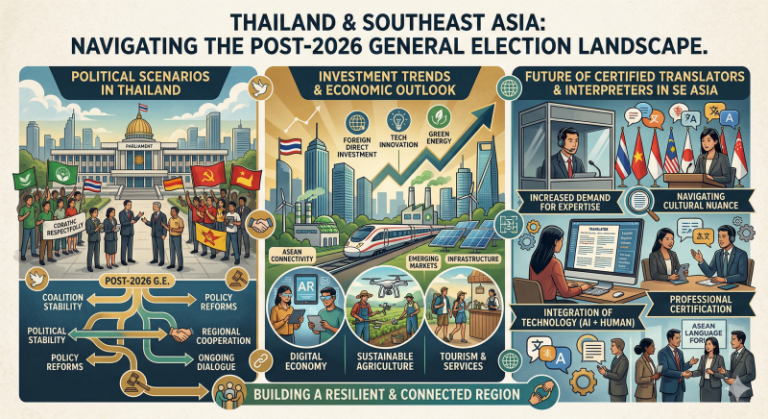
3. Political Scenarios in Thailand after the 2026 Election
3.1 Base Scenario: Managed Stability
The election results led to the formation of a coalition government with a parliamentary majority, reducing short-term political uncertainty (Associated Press, 2026). However, this stability remains constrained by internal power negotiations within the coalition.
3.2 Positive Scenario: Reform Acceleration
If the government successfully advances constitutional and economic reforms simultaneously, investor confidence could increase significantly (ConstitutionNet, 2026).
3.3 Negative Scenario: Fragile Stability
If economic policies are delayed and reforms stagnate, Thailand may continue to experience low economic growth, projected at approximately 1.6% (World Bank, 2026).
4. Investment Trends after the Election
4.1 Short-Term Market Reactions
Financial markets responded positively to the election outcome, reflecting reduced uncertainty (Nation Thailand, 2026).
4.2 Structural Shifts in FDI
Data from the Board of Investment (BOI) indicate that investment is increasingly concentrated in:
- Digital infrastructure and data centers
- Advanced electronics industries
- Clean energy and electric vehicles
These trends reflect Thailand’s transition toward a technology-driven economy (Bangkok Investment Office, 2025).
4.3 Macroeconomic Constraints
Despite increased investment activity, economic growth remains constrained by structural issues such as labor productivity and global competitiveness (World Bank, 2026).
5. The Future of Certified Translation and Interpreting Professions
5.1 The Impact of AI on Language Professions
AI has reduced translation costs and increased efficiency, while simultaneously decreasing demand for routine translation work (Thomson Reuters, 2026).
5.2 Transition to Language Risk Professionals
Certified translators and interpreters are transitioning from “language producers” to “language risk professionals”, responsible for ensuring accuracy, reliability, and accountability, particularly in legal and governmental contexts.
5.3 The Role of SEAProTI in Professional Standardization
SEAProTI has developed certification systems that include:
- Professional registration
- Certification renewal
- Continuing Professional Development (CPD)
These mechanisms enhance professional credibility and standardization (SEAProTI, 2024).
5.4 The Future of Certified Interpreters
Certified interpreters remain essential in high-stakes environments such as courts and healthcare, where AI cannot fully replicate ethical judgment, contextual interpretation, and human interaction.
6. Discussion
The findings indicate that political stability is a necessary but insufficient condition for attracting investment. Long-term success depends on effective policy implementation and structural reforms.
In the language profession, technological disruption does not eliminate jobs but instead redefines and elevates professional roles, particularly in areas requiring legal responsibility and ethical judgment.
7. Conclusion
Post-election Thailand in 2026 is characterized by transitional stability, creating opportunities for investment while maintaining structural challenges. Meanwhile, certified translation and interpreting professions are expected to evolve qualitatively, emphasizing roles related to verification, accountability, and professional responsibility.
References
- Associated Press. (2026). Thailand’s ruling conservative party moves closer to forming a new coalition government.
- Bangkok Investment Office. (2025). Thailand’s investment applications reach new highs in 2025, fueled by digital and advanced industries.
- ConstitutionNet. (2026). Thailand’s 2026 constitutional referendum: A step towards reform or a symbolic victory?
- Nation Thailand. (2026). The Thai stock market reacts positively after the election results.
- SEAProTI. (2024). Official recognition and professional standards by the Southeast Asian Association of Professional Translators and Interpreters.
- Thomson Reuters. (2026). AI in professional services report 2026.
- World Bank. (2026). Thailand economic monitor: Advanced green manufacturing for growth.
For professional services, please visit: https://www.seaproti.org/practitioners/
About certified translators, translation certifiers, and certified interpreters associated with SEAProTI.
The Southeast Asian Association of Professional Translators and Interpreters (SEAProTI) has officially shared the qualifications and requirements for becoming Certified Translators, Translation Certification Providers, and Certified Interpreters in Sections 9 and 10 of the Royal Gazette, which was published by the Prime Minister’s Office in Thailand on July 25, 2024. Certified Translators, Translation Certification Providers, and Certified Interpreters
The Council of State has proposed the enactment of a Royal Decree, granting registered translators and recognised translation certifiers from professional associations or accredited language institutions the authority to provide legally valid translation certification (Letter to SEAProTI dated April 28, 2025)
SEAProTI is the first professional association in Thailand and Southeast Asia to implement a comprehensive certification system for translators, certifiers, and interpreters.
Head Office: Baan Ratchakru Building, No. 33, Room 402, Soi Phahonyothin 5, Phahonyothin Road, Phaya Thai District, Bangkok 10400, Thailand
Email: hello@seaproti.com | Tel.: (+66) 2-114-3128 (Office hours: Mon–Fri, 09:00–17:00).
ฉากทัศน์การเมืองไทยหลังการเลือกตั้ง พ.ศ. 2569 แนวโน้มการลงทุน
และอนาคตของวิชาชีพนักแปลรับรองและล่ามรับรองในบริบทเอเชียตะวันออกเฉียงใต้
ผู้แต่ง วณิชชา สุมานัส นายกสมาคมวิชาชีพนักแปลและล่ามแห่งเอเชียตะวันออกเฉียงใต้ และนักนิติภาษาศาสตร์วิชาชีพ
6 เมษายน 2569, กรุงเทพ – บทความนี้วิเคราะห์ฉากทัศน์การเมืองไทยภายหลังการเลือกตั้งทั่วไป พ.ศ. 2569 และประเมินผลกระทบต่อแนวโน้มการลงทุนทั้งในประเทศและต่างประเทศ ควบคู่กับการศึกษาการเปลี่ยนแปลงเชิงโครงสร้างของวิชาชีพนักแปลรับรอง ผู้รับรองการแปล และล่ามรับรอง ภายใต้บริบทของสมาคมวิชาชีพนักแปลและล่ามแห่งเอเชียตะวันออกเฉียงใต้ (SEAProTI) ผลการวิเคราะห์ชี้ให้เห็นว่าความชัดเจนทางการเมืองส่งผลเชิงบวกต่อความเชื่อมั่นของตลาดในระยะสั้น อย่างไรก็ตาม ความยั่งยืนของการลงทุนขึ้นอยู่กับความสามารถของรัฐบาลในการดำเนินนโยบายเชิงโครงสร้าง ในขณะเดียวกัน เทคโนโลยีปัญญาประดิษฐ์ได้เปลี่ยนบทบาทของวิชาชีพภาษาไปสู่การเป็นผู้เชี่ยวชาญด้านความเสี่ยงทางภาษา (language risk professional) มากขึ้น โดยเฉพาะในงานที่มีผลทางกฎหมายและจริยธรรม
1. บทนำ
การเลือกตั้งทั่วไปของประเทศไทยในปี พ.ศ. 2569 นับเป็นจุดเปลี่ยนสำคัญในเชิงโครงสร้างทางการเมืองและเศรษฐกิจ เนื่องจากเป็นช่วงเวลาที่ประเทศไทยเผชิญกับความท้าทายทั้งด้านการเติบโตทางเศรษฐกิจต่ำ ความไม่แน่นอนของเศรษฐกิจโลก และการเปลี่ยนผ่านเทคโนโลยีอย่างรวดเร็ว โดยเฉพาะการเข้ามาของปัญญาประดิษฐ์ (AI) ที่ส่งผลต่อวิชาชีพจำนวนมาก รวมถึงวิชาชีพด้านภาษา
บทความนี้มีวัตถุประสงค์เพื่อ (1) วิเคราะห์ฉากทัศน์ทางการเมืองหลังการเลือกตั้ง (2) ประเมินแนวโน้มการลงทุน และ (3) ศึกษาอนาคตของวิชาชีพนักแปลและล่ามรับรองในบริบทของ SEAProTI
2. กรอบแนวคิดการวิเคราะห์
การศึกษานี้ใช้กรอบการวิเคราะห์แบบบูรณาการระหว่าง
- เศรษฐศาสตร์การเมือง (political economy)
- การลงทุนระหว่างประเทศ (FDI dynamics)
- การเปลี่ยนแปลงเชิงเทคโนโลยี (AI disruption)
โดยเน้นความสัมพันธ์ระหว่าง “เสถียรภาพทางการเมือง – ความเชื่อมั่นนักลงทุน – โครงสร้างแรงงานวิชาชีพ”
3. ฉากทัศน์การเมืองไทยหลังการเลือกตั้ง พ.ศ. 2569
3.1 ฉากทัศน์ฐาน: เสถียรภาพแบบประคอง (Managed Stability)
ผลการเลือกตั้งนำไปสู่การจัดตั้งรัฐบาลผสมที่มีเสียงข้างมากในสภา ส่งผลให้ความเสี่ยงทางการเมืองลดลงในระยะสั้น (Associated Press, 2026) อย่างไรก็ตาม เสถียรภาพดังกล่าวยังอยู่ภายใต้ข้อจำกัดของการต่อรองเชิงอำนาจภายในรัฐบาล
3.2 ฉากทัศน์บวก: การปฏิรูปเชิงโครงสร้าง (Reform Acceleration)
หากรัฐบาลสามารถดำเนินการปฏิรูประบบรัฐธรรมนูญและเศรษฐกิจควบคู่กัน จะส่งผลให้ความเชื่อมั่นของนักลงทุนเพิ่มขึ้นอย่างมีนัยสำคัญ (ConstitutionNet, 2026)
3.3 ฉากทัศน์ลบ: เสถียรภาพเชิงผิวหน้า (Fragile Stability)
ในกรณีที่นโยบายเศรษฐกิจล่าช้าและการปฏิรูปไม่คืบหน้า เศรษฐกิจไทยอาจเติบโตในระดับต่ำต่อเนื่อง โดยมีการคาดการณ์การเติบโตเพียง 1.6% (World Bank, 2026)
4. แนวโน้มการลงทุนหลังการเลือกตั้ง
4.1 ปฏิกิริยาระยะสั้นของตลาดการเงิน
ตลาดทุนตอบสนองเชิงบวกต่อผลการเลือกตั้ง เนื่องจากความไม่แน่นอนลดลง (Nation Thailand, 2026)
4.2 การเปลี่ยนแปลงเชิงโครงสร้างของ FDI
ข้อมูลจาก BOI แสดงให้เห็นว่าการลงทุนมุ่งสู่
- ดิจิทัลและศูนย์ข้อมูล (data centers)
- อุตสาหกรรมอิเล็กทรอนิกส์ขั้นสูง
- พลังงานสะอาดและยานยนต์ไฟฟ้า
ซึ่งสะท้อนการปรับตัวของไทยเข้าสู่เศรษฐกิจเทคโนโลยี (Bangkok Investment Office, 2025)
4.3 ข้อจำกัดเชิงมหภาค
แม้จะมีการลงทุนเพิ่มขึ้น แต่การเติบโตทางเศรษฐกิจยังถูกจำกัดด้วยปัจจัยเชิงโครงสร้าง เช่น ผลิตภาพแรงงานและการแข่งขันระหว่างประเทศ (World Bank, 2026)
5. อนาคตของวิชาชีพนักแปลรับรองและล่ามรับรอง
5.1 ผลกระทบของ AI ต่อวิชาชีพภาษา
AI ส่งผลให้ต้นทุนการแปลลดลงและเพิ่มประสิทธิภาพการผลิตงาน แต่ในขณะเดียวกันก็ลดความต้องการแรงงานในงานแปลทั่วไป (Thomson Reuters, 2026)
5.2 การเปลี่ยนบทบาทสู่ Language Risk Professional
วิชาชีพนักแปลรับรองและล่ามรับรองกำลังเปลี่ยนบทบาทจาก “ผู้ผลิตภาษา” ไปเป็น “ผู้รับรองความถูกต้องและความน่าเชื่อถือ” ของข้อมูล โดยเฉพาะในบริบททางกฎหมายและราชการ
5.3 บทบาทของ SEAProTI ในการกำหนดมาตรฐานวิชาชีพ
SEAProTI ได้พัฒนาระบบรับรองวิชาชีพ เช่น
- การขึ้นทะเบียน
- การต่ออายุใบรับรอง
- การพัฒนาวิชาชีพต่อเนื่อง (CPD)
ซึ่งช่วยสร้างความน่าเชื่อถือและยกระดับมาตรฐานวิชาชีพ (SEAProTI, 2024)
5.4 แนวโน้มของล่ามรับรอง
ล่ามในบริบทที่มีความเสี่ยงสูง เช่น ศาลและการแพทย์ ยังคงมีความต้องการสูง เนื่องจาก AI ยังไม่สามารถทดแทนความสามารถด้านจริยธรรมและการตัดสินใจเชิงบริบทได้
6. อภิปรายผล
ผลการศึกษาชี้ให้เห็นว่า “เสถียรภาพทางการเมือง” เป็นเพียงเงื่อนไขจำเป็นแต่ไม่เพียงพอสำหรับการดึงดูดการลงทุน ความสำเร็จในระยะยาวขึ้นอยู่กับความสามารถในการดำเนินนโยบายเชิงโครงสร้าง
ในด้านวิชาชีพภาษา การเปลี่ยนแปลงทางเทคโนโลยีไม่ได้ทำให้วิชาชีพหายไป แต่กลับทำให้เกิดการ “ยกระดับบทบาท” โดยเฉพาะในงานที่ต้องการความรับผิดชอบทางกฎหมายและจริยธรรม
7. สรุป
ประเทศไทยหลังการเลือกตั้ง พ.ศ. 2569 อยู่ในช่วงของ “เสถียรภาพเชิงเปลี่ยนผ่าน” ซึ่งเปิดโอกาสต่อการลงทุน แต่ยังต้องเผชิญกับความท้าทายเชิงโครงสร้าง ในขณะเดียวกัน วิชาชีพนักแปลและล่ามรับรองมีแนวโน้มเติบโตในเชิงคุณภาพ โดยเฉพาะในบทบาทที่เกี่ยวข้องกับการรับรองความถูกต้อง ความน่าเชื่อถือ และความรับผิดทางวิชาชีพ
เอกสารอ้างอิง
- Associated Press. (2026). Thailand’s ruling conservative party moves closer to forming new coalition government.
- Bangkok Investment Office. (2025). Thailand’s investment applications reach new highs in 2025, fueled by digital and advanced industries.
- ConstitutionNet. (2026). Thailand’s 2026 constitutional referendum: A step towards reform or a symbolic victory?
- Nation Thailand. (2026). The Thai stock market reacts positively after the election results.
- SEAProTI. (2024). Official recognition and professional standards by the Southeast Asian Association of Professional Translators and Interpreters.
- Thomson Reuters. (2026). AI in professional services report 2026.
- World Bank. (2026). Thailand economic monitor: Advanced green manufacturing for growth.
ติดต่อขอใช้บริการนักวิชาชีพของสมาคมได้ที่: https://www.seaproti.org/practitioners/
สมาคมวิชาชีพนักแปลและล่ามแห่งเอเชียตะวันออกเฉียงใต้ (SEAProTI) ได้ประกาศหลักเกณฑ์และคุณสมบัติของผู้ที่ขึ้นทะเบียนเป็น “นักแปลรับรอง (Certified Translators) และผู้รับรองการแปล (Translation Certification Providers) และล่ามรับรอง (Certified Interpreters)” ของสมาคม หมวดที่ 9 และหมวดที่ 10 ในราชกิจจานุเบกษา ของสำนักเลขาธิการคณะรัฐมนตรี ในสำนักนายกรัฐมนตรี แห่งราชอาณาจักรไทย ลงวันที่ 25 ก.ค. 2567 เล่มที่ 141 ตอนที่ 66 ง หน้า 100 อ่านฉบับเต็มได้ที่: นักแปลรับรอง ผู้รับรองการแปล และล่ามรับรอง
สำนักคณะกรรมการกฤษฎีกาเสนอให้ตราเป็นพระราชกฤษฎีกา โดยกำหนดให้นักแปลที่ขึ้นทะเบียน รวมถึงผู้รับรองการแปลจากสมาคมวิชาชีพหรือสถาบันสอนภาษาที่มีการอบรมและขึ้นทะเบียน สามารถรับรองคำแปลได้ (จดหมายถึงสมาคม SEAProTI ลงวันที่ 28 เม.ย. 2568)
สมาคมวิชาชีพนักแปลและล่ามแห่งเอเชียตะวันออกเฉียงใต้เป็นสมาคมวิชาชีพแห่งแรกและแห่งเดียวในประเทศไทยและภูมิภาคเอเชียตะวันออกเฉียงใต้ที่มีระบบรับรองนักแปลรับรอง ผู้รับรองการแปล และล่ามรับรอง
สำนักงานใหญ่: อาคารบ้านราชครู เลขที่ 33 ห้อง 402 ซอยพหลโยธิน 5 ถนนพหลโยธิน แขวงพญาไท เขตพญาไท กรุงเทพมหานคร 10400 ประเทศไทย
อีเมล: hello@seaproti.com โทรศัพท์: (+66) 2-114-3128 (เวลาทำการ: วันจันทร์–วันศุกร์ เวลา 09.00–17.00 น.