



Meaning and Historical Background of Royal Vocabulary in the Thai Language
6 April 2026, Bangkok – Royal vocabulary is an essential component of the Thai language that reflects social structure, culture, and values of respect within Thai society. This article aims to study the meaning, origin, development, and benefits of royal vocabulary in Thai by drawing on Thai language textbooks. The findings indicate that royal vocabulary has developed alongside the history of the Thai nation, has been influenced by foreign languages, and plays an important role in the appropriate use of language according to social status.
Keywords: Royal vocabulary, Thai language, Thai culture, linguistics
The Thai language is a cultural heritage that reflects national identity and serves as a communication tool with diverse forms and levels. In particular, “royal vocabulary” is a language form used to express respect toward individuals of high status, such as the King, members of the royal family, Buddhist monks, and other respected individuals in society. Therefore, the use of royal vocabulary is not only related to language but also reflects the culture and values of Thai society.
Meaning of Royal Vocabulary
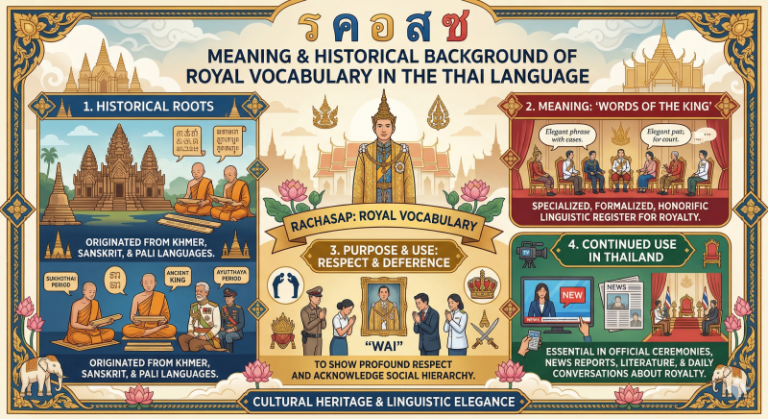
Royal vocabulary is a compound word consisting of “rāja” (from Pali and Sanskrit), meaning king, and “ศัพท์” (sap), meaning word or speech. According to the Royal Institute Dictionary (1999), royal vocabulary refers to specific terms used for the King and royalty, and later extended to include words used for monks, government officials, and polite members of society (Royal Institute, 1999).
Historical Background of Royal Vocabulary
The exact origin of royal vocabulary cannot be clearly determined due to the lack of evidence before the Sukhothai period. However, evidence from the Sukhothai era, particularly during the reign of King Lithai (Mahathammaracha I), shows the use of elevated language in literary works such as Traibhumikatha.
In the Ayutthaya period, royal vocabulary became more developed and systematized, appearing in legal documents and official records such as the Three Seals Law and the Palace Law. These documents demonstrate the formalization of language use for the monarchy and the royal court.
Additionally, royal vocabulary has been influenced by foreign languages such as Pali, Sanskrit, and Khmer, which have played a significant role in word formation and vocabulary expansion in Thai.
Characteristics and Sources of Royal Vocabulary
Royal vocabulary in Thai has several key characteristics:
- Borrowing words from foreign languages such as Pali, Sanskrit, and Khmer
- Creating new words through compounding
- Using native Thai words with prefixes such as “phra” or “phra ratcha.”
Using specific terms instead of common words, for example:
- “eat” → “sawoei” (เสวย)
- “sleep” → “banthom” (บรรทม)
Additionally, the word “song” (ทรง) is used as a prefix for verbs and nouns to show respect, such as “song phra ratcha nipon” (to compose royally) or “song ma” (to ride a horse).
Benefits of Studying Royal Vocabulary
The study of royal vocabulary provides several benefits:
- It enables correct and appropriate language use according to context
- It helps in understanding texts that use royal vocabulary accurately
- It promotes refinement and politeness in language use
- It reflects Thai culture and societal values
- It enhances linguistic skills and expands vocabulary knowledge
Discussion
The study shows that royal vocabulary is a product of linguistic and social development, closely related to power structures and social hierarchy in Thai society. Its continued use demonstrates the importance of language as a cultural reflection and serves as an indicator of linguistic competence and social awareness among language users.
Conclusion
Royal vocabulary is a crucial component of the Thai language that is deeply connected to history, culture, and society. Studying royal vocabulary helps develop a deeper understanding of Thai linguistic structure and enables appropriate language use. Therefore, preserving and promoting the use of royal vocabulary is essential for maintaining the cultural heritage of the nation.
References
- Royal Institute. (1999). Royal Institute Dictionary B.E. 2542. Bangkok: Royal Institute.
- (Unknown author). (n.d.). Royal vocabulary. (Instructional document).
For professional services, please visit: https://www.seaproti.org/practitioners/
About certified translators, translation certifiers, and certified interpreters associated with SEAProTI.
The Southeast Asian Association of Professional Translators and Interpreters (SEAProTI) has officially shared the qualifications and requirements for becoming Certified Translators, Translation Certification Providers, and Certified Interpreters in Sections 9 and 10 of the Royal Gazette, which was published by the Prime Minister’s Office in Thailand on July 25, 2024. Certified Translators, Translation Certification Providers, and Certified Interpreters
The Council of State has proposed the enactment of a Royal Decree, granting registered translators and recognised translation certifiers from professional associations or accredited language institutions the authority to provide legally valid translation certification (Letter to SEAProTI dated April 28, 2025)
SEAProTI is the first professional association in Thailand and Southeast Asia to implement a comprehensive certification system for translators, certifiers, and interpreters.
Head Office: Baan Ratchakru Building, No. 33, Room 402, Soi Phahonyothin 5, Phahonyothin Road, Phaya Thai District, Bangkok 10400, Thailand
Email: hello@seaproti.com | Tel.: (+66) 2-114-3128 (Office hours: Mon–Fri, 09:00–17:00).
ความหมายและประวัติความเป็นมาของราชาศัพท์ในภาษาไทย
ราชาศัพท์เป็นองค์ประกอบสำคัญของภาษาไทยที่สะท้อนถึงโครงสร้างทางสังคม วัฒนธรรม และค่านิยมเรื่องความเคารพในสังคมไทย บทความนี้มีวัตถุประสงค์เพื่อศึกษาความหมาย ที่มา พัฒนาการ และประโยชน์ของราชาศัพท์ในภาษาไทย โดยอาศัยข้อมูลจากเอกสารตำราภาษาไทย พบว่าราชาศัพท์มีพัฒนาการควบคู่กับประวัติศาสตร์ชาติไทย ได้รับอิทธิพลจากภาษาต่างประเทศ และมีบทบาทสำคัญในการใช้ภาษาอย่างเหมาะสมตามฐานะบุคคล
คำสำคัญ: ราชาศัพท์, ภาษาไทย, วัฒนธรรมไทย, ภาษาศาสตร์
ภาษาไทยเป็นมรดกทางวัฒนธรรมที่สะท้อนอัตลักษณ์ของชาติ และเป็นเครื่องมือในการสื่อสารที่มีความหลากหลายทั้งในด้านรูปแบบและระดับภาษา โดยเฉพาะอย่างยิ่ง “ราชาศัพท์” ซึ่งเป็นรูปแบบภาษาที่ใช้แสดงความเคารพต่อบุคคลที่มีฐานะสูง เช่น พระมหากษัตริย์ พระบรมวงศานุวงศ์ พระภิกษุ และบุคคลในสังคมที่ควรได้รับการยกย่อง การใช้ราชาศัพท์จึงไม่เพียงแต่เกี่ยวข้องกับภาษาเท่านั้น แต่ยังสะท้อนถึงวัฒนธรรมและค่านิยมของสังคมไทยอีกด้วย
ความหมายของราชาศัพท์
ราชาศัพท์เป็นคำสมาสที่ประกอบด้วยคำว่า “ราช” หรือ “ราชา” ซึ่งมีที่มาจากภาษาบาลีและสันสกฤต และคำว่า “ศัพท์” ซึ่งหมายถึงถ้อยคำหรือคำพูด ตามพจนานุกรมฉบับราชบัณฑิตยสถาน (2542) ราชาศัพท์หมายถึงคำเฉพาะที่ใช้สำหรับพระมหากษัตริย์และเจ้านาย และต่อมาขยายความหมายให้รวมถึงคำที่ใช้กับพระภิกษุ ข้าราชการ และสุภาพชน (ราชบัณฑิตยสถาน, 2542)
ประวัติความเป็นมาของราชาศัพท์
การกำเนิดของราชาศัพท์ไม่สามารถระบุช่วงเวลาได้อย่างชัดเจน เนื่องจากขาดหลักฐานในช่วงก่อนสมัยสุโขทัย อย่างไรก็ตาม หลักฐานในสมัยสุโขทัย โดยเฉพาะในรัชสมัยพระมหาธรรมราชาที่ 1 (พระยาลิไทย) แสดงให้เห็นถึงการใช้ภาษาในระดับสูงในวรรณกรรม เช่น ไตรภูมิพระร่วง
ต่อมาในสมัยกรุงศรีอยุธยา ราชาศัพท์ได้รับการพัฒนาและใช้อย่างเป็นระบบมากขึ้น โดยปรากฏในกฎหมายและเอกสารราชการ เช่น กฎหมายตราสามดวง และกฎมณเฑียรบาล ซึ่งแสดงถึงการกำหนดแบบแผนการใช้ภาษาสำหรับพระมหากษัตริย์และราชสำนัก
นอกจากนี้ ราชาศัพท์ยังได้รับอิทธิพลจากภาษาต่างประเทศ เช่น บาลี สันสกฤต และเขมร ซึ่งมีบทบาทสำคัญในการสร้างคำและขยายคำศัพท์ในภาษาไทย
ลักษณะและที่มาของราชาศัพท์
ราชาศัพท์ในภาษาไทยมีลักษณะสำคัญ ได้แก่
- การยืมคำจากภาษาต่างประเทศ เช่น บาลี สันสกฤต และเขมร
- การสร้างคำใหม่โดยการประสมคำ
- การใช้คำไทยเดิมร่วมกับคำเติม เช่น “พระ” หรือ “พระราช”
- การใช้คำเฉพาะแทนคำสามัญ เช่น
- กิน → เสวย
- นอน → บรรทม
นอกจากนี้ ยังมีการใช้คำว่า “ทรง” นำหน้าคำกริยาและคำนามเพื่อแสดงความเคารพ เช่น “ทรงพระราชนิพนธ์” หรือ “ทรงม้า”
ประโยชน์ของการใช้ราชาศัพท์
การศึกษาราชาศัพท์มีประโยชน์หลายประการ ได้แก่
- ทำให้สามารถใช้ภาษาได้อย่างถูกต้องและเหมาะสมกับบริบท
- ช่วยให้เข้าใจข้อความที่ใช้ราชาศัพท์ได้อย่างถูกต้อง
- ส่งเสริมความประณีตและความสุภาพในการใช้ภาษา
- สะท้อนถึงวัฒนธรรมและค่านิยมของสังคมไทย
- ช่วยพัฒนาทักษะทางภาษาและเพิ่มพูนคลังคำศัพท์
อภิปรายผล
จากการศึกษาพบว่าราชาศัพท์เป็นผลผลิตของพัฒนาการทางภาษาและสังคม โดยมีความสัมพันธ์กับโครงสร้างอำนาจและลำดับชั้นในสังคมไทย การคงอยู่ของราชาศัพท์แสดงให้เห็นถึงความสำคัญของภาษาในฐานะเครื่องมือสะท้อนวัฒนธรรม และยังเป็นตัวชี้วัดความสามารถทางภาษาและความเข้าใจบริบททางสังคมของผู้ใช้ภาษา
สรุป
ราชาศัพท์เป็นองค์ประกอบสำคัญของภาษาไทยที่มีความเกี่ยวข้องกับประวัติศาสตร์ วัฒนธรรม และสังคม การศึกษาราชาศัพท์ช่วยให้เข้าใจโครงสร้างภาษาไทยอย่างลึกซึ้ง และสามารถใช้ภาษาได้อย่างถูกต้องเหมาะสม การอนุรักษ์และส่งเสริมการใช้ราชาศัพท์จึงเป็นสิ่งจำเป็นเพื่อรักษามรดกทางวัฒนธรรมของชาติ
เอกสารอ้างอิง
- ราชบัณฑิตยสถาน. (2542). พจนานุกรมฉบับราชบัณฑิตยสถาน พ.ศ. 2542. กรุงเทพฯ: ราชบัณฑิตยสถาน.
- (ไม่ปรากฏชื่อผู้แต่ง). (ม.ป.ป.). ราชาศัพท์. (เอกสารประกอบการเรียน).
ติดต่อขอใช้บริการนักวิชาชีพของสมาคมได้ที่: https://www.seaproti.org/practitioners/
สมาคมวิชาชีพนักแปลและล่ามแห่งเอเชียตะวันออกเฉียงใต้ (SEAProTI) ได้ประกาศหลักเกณฑ์และคุณสมบัติของผู้ที่ขึ้นทะเบียนเป็น “นักแปลรับรอง (Certified Translators) และผู้รับรองการแปล (Translation Certification Providers) และล่ามรับรอง (Certified Interpreters)” ของสมาคม หมวดที่ 9 และหมวดที่ 10 ในราชกิจจานุเบกษา ของสำนักเลขาธิการคณะรัฐมนตรี ในสำนักนายกรัฐมนตรี แห่งราชอาณาจักรไทย ลงวันที่ 25 ก.ค. 2567 เล่มที่ 141 ตอนที่ 66 ง หน้า 100 อ่านฉบับเต็มได้ที่: นักแปลรับรอง ผู้รับรองการแปล และล่ามรับรอง
สำนักคณะกรรมการกฤษฎีกาเสนอให้ตราเป็นพระราชกฤษฎีกา โดยกำหนดให้นักแปลที่ขึ้นทะเบียน รวมถึงผู้รับรองการแปลจากสมาคมวิชาชีพหรือสถาบันสอนภาษาที่มีการอบรมและขึ้นทะเบียน สามารถรับรองคำแปลได้ (จดหมายถึงสมาคม SEAProTI ลงวันที่ 28 เม.ย. 2568)
สมาคมวิชาชีพนักแปลและล่ามแห่งเอเชียตะวันออกเฉียงใต้เป็นสมาคมวิชาชีพแห่งแรกและแห่งเดียวในประเทศไทยและภูมิภาคเอเชียตะวันออกเฉียงใต้ที่มีระบบรับรองนักแปลรับรอง ผู้รับรองการแปล และล่ามรับรอง
สำนักงานใหญ่: อาคารบ้านราชครู เลขที่ 33 ห้อง 402 ซอยพหลโยธิน 5 ถนนพหลโยธิน แขวงพญาไท เขตพญาไท กรุงเทพมหานคร 10400 ประเทศไทย
อีเมล: hello@seaproti.com โทรศัพท์: (+66) 2-114-3128 (เวลาทำการ: วันจันทร์–วันศุกร์ เวลา 09.00–17.00 น.