


Word Formation and Thai Legal Terminology: A Legal-Linguistic Analysis of Access to Justice and Citizens’ Rights
28 December 2025, Bangkok – Language is a fundamental mechanism of law. Legal systems cannot exist without language to define rights, obligations, and state authority. However, legal language is not merely a technical instrument; it is a symbolic system that must communicate meaningfully with citizens, who are the ultimate holders of sovereignty. In the Thai legal context, a significant number of new legal terms have been formally coined through statutes and subordinate legislation, with the stated aim of promoting clarity and standardization. In practice, however, many of these terms are not adopted in everyday language use and fail to generate derivative forms through natural linguistic processes such as word formation. This phenomenon raises a central question in legal linguistics: how does the failure of legal terminology to be used and to generate “word offspring” affect access to justice and the protection of citizens’ rights?
Research Objectives
This article aims to (1) analyze the concept of word formation as an indicator of lexical vitality from an evolutionary linguistic perspective; (2) examine concrete cases of Thai legal terminology that fail to generate derivative forms; and (3) discuss the legal-linguistic implications of this phenomenon for access to justice and the realization of citizens’ rights within the Thai legal system.
Theoretical Framework: Legal Linguistics and Linguistic Evolution
This study adopts a usage-based linguistic framework, which views language as emerging and evolving through actual patterns of use rather than through prescriptive regulation alone (Bybee, 2006). It is complemented by insights from cognitive linguistics, which explain lexical choice and retention in terms of familiarity, experiential grounding, and cognitive processing costs (Langacker, 2008). From a legal-linguistic perspective, legal language should therefore be evaluated not only for doctrinal correctness but also for its communicative effectiveness and fairness across different groups of legal users.
Word Formation as an Index of Lexical Vitality
Word formation refers to the capacity of a lexical item to generate new forms, meanings, or grammatical functions while retaining its core semantic content. Terms that successfully generate derivative forms typically indicate that users have internalized them as part of their active lexicon and can deploy them flexibly across contexts. Conversely, the absence of word formation suggests that a term has not been fully integrated into the linguistic system of its users and remains restricted to formal or institutional contexts.
Thai Legal Terminology That Fails to Generate Word Offspring
Within the Thai legal system, numerous officially coined legal terms remain confined to statutory texts and administrative documents, with little or no extension into professional or everyday usage. Such terms are often characterized by lengthy structures, abstract nominalization, or syntactic patterns that diverge from everyday Thai usage. As a result, they are rarely abbreviated, compounded, or repurposed as bases for new lexical constructions. These terms remain linguistically rigid, functioning solely within the textual boundaries of the law and lacking cognitive resonance with the general public.
In contrast, legal terms that are widely used in practice often generate derivative forms, extended meanings, or colloquial adaptations. This linguistic productivity reduces the communicative distance between legal discourse and everyday language. Terms that fail to generate word offspring, by contrast, reinforce the perception of legal language as an exclusive domain of experts and widen the gap between law and society.
Implications for Access to Justice and Citizens’ Rights
From a legal-linguistic standpoint, legal terms that do not generate word offspring pose a direct obstacle to access to justice. When citizens are unfamiliar with legal terminology and cannot map statutory language onto lived experience, their ability to recognize rights, assert claims, or participate meaningfully in legal processes is diminished. Legal rights that cannot be linguistically grasped are, in effect, rights that are difficult to exercise.
Furthermore, such terminology increases interpretive burdens on judges and administrative officials, who must translate abstract statutory language into comprehensible meaning. This process not only reduces procedural efficiency but also creates space for inconsistent interpretation and discretionary application, potentially undermining legal certainty and equality before the law.
Discussion
The findings suggest that the failure of Thai legal terminology to generate word offspring is not merely a linguistic issue but a structural problem of legal communication. Coining legal terms without regard to linguistic evolution and cognitive processing risks producing a legal language that is formally precise yet socially inaccessible. This disconnect undermines the foundational role of law as a mechanism for rights protection and social justice.
Conclusion
This article proposes that word formation can serve as a legal-linguistic indicator of the vitality and accessibility of Thai legal terminology. Legal terms that fail to generate derivative forms reveal a breakdown in the connection between statutory language and the linguistic practices of citizens, with significant implications for access to justice. Future legal drafting should therefore balance doctrinal precision with linguistic naturalness, taking into account the evolutionary and cognitive dynamics of language use. Only then can legal language function not merely as enforceable text, but as a living instrument of justice within society.
- Bybee, J. (2006). From usage to grammar: The mind’s response to repetition. Language, 82(4), 711–733.
- Crystal, D. (2010). The Cambridge encyclopedia of language (3rd ed.). Cambridge University Press.
- Evans, V., & Green, M. (2006). Cognitive linguistics: An introduction. Edinburgh University Press.
- Langacker, R. W. (2008). Cognitive grammar: A basic introduction. Oxford University Press.
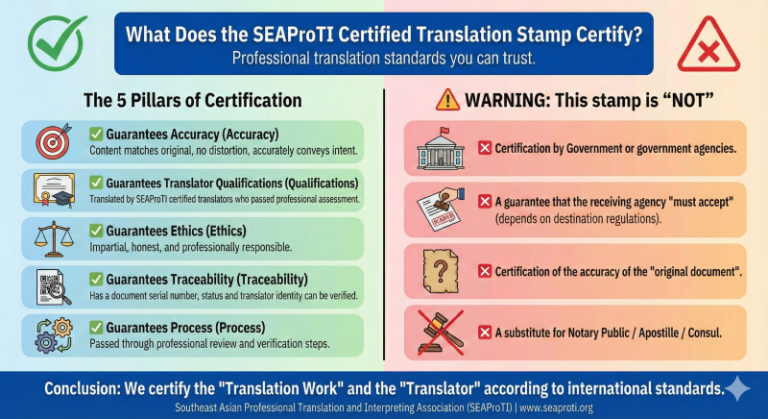
The Southeast Asian Association of Professional Translators and Interpreters (SEAProTI) has formally announced the qualifications and requirements for registration of Certified Translators, Translation Certification Providers, and Certified Interpreters in Sections 9 and 10 of the Royal Gazette, published by the Secretariat of the Cabinet, Office of the Prime Minister of Thailand, on 25 July 2024 (Vol. 141, Part 66 Ng, p. 100). Certified Translators, Translation Certification Providers, and Certified Interpreters
The Council of State has proposed the enactment of a Royal Decree, granting registered translators and recognised translation certifiers from professional associations or accredited language institutions the authority to provide legally valid translation certification (Letter to SEAProTI dated April 28, 2025)
SEAProTI is the first professional association in Thailand and Southeast Asia to implement a comprehensive certification system for translators, certifiers, and interpreters.
Head Office: Baan Ratchakru Building, No. 33, Room 402, Soi Phahonyothin 5, Phahonyothin Road, Phaya Thai District, Bangkok 10400, Thailand
Email: hello@seaproti.com | Tel.: (+66) 2-114-3128 (Office hours: Mon–Fri, 09:00–17:00)
การสร้างคำลูกกับศัพท์กฎหมายไทย: การวิเคราะห์เชิงนิติภาษาศาสตร์ต่อการเข้าถึงความยุติธรรมและสิทธิของประชาชน
28 ธันวาคม 2568, กรุงเทพมหานคร – ภาษาเป็นกลไกพื้นฐานของกฎหมาย เนื่องจากกฎหมายไม่อาจดำรงอยู่ได้โดยปราศจากภาษาในการนิยามสิทธิ หน้าที่ และอำนาจรัฐ อย่างไรก็ตาม ภาษาในกฎหมายมิได้เป็นเพียงเครื่องมือเชิงเทคนิค หากแต่เป็นระบบสัญลักษณ์ที่ต้องสื่อสารกับประชาชนผู้เป็นเจ้าของอำนาจอธิปไตยโดยตรง ในบริบทของกฎหมายไทย พบว่ามีการบัญญัติศัพท์ทางกฎหมายขึ้นใหม่จำนวนมาก โดยมีวัตถุประสงค์เพื่อสร้างความชัดเจนและเป็นมาตรฐานเดียวกัน แต่ในทางปฏิบัติ ศัพท์เหล่านี้จำนวนหนึ่งไม่ถูกนำไปใช้ในภาษาชีวิตจริง และไม่ก่อให้เกิดการต่อยอดทางภาษา เช่น การสร้างคำลูก ปรากฏการณ์ดังกล่าวก่อให้เกิดคำถามเชิงนิติภาษาศาสตร์ว่า ศัพท์กฎหมายที่ไม่ถูกใช้และไม่ก่อคำลูกส่งผลอย่างไรต่อการเข้าถึงความยุติธรรมและสิทธิของประชาชน
วัตถุประสงค์ของการศึกษา
บทความนี้มีวัตถุประสงค์เพื่อ (1) วิเคราะห์แนวคิดเรื่องการสร้างคำลูกในฐานะตัวชี้วัดความมีชีวิตของคำในเชิงวิวัฒนาการทางภาษา (2) ศึกษากรณีศัพท์กฎหมายไทยที่ไม่ก่อคำลูกอย่างเป็นรูปธรรม และ (3) อภิปรายผลกระทบเชิงนิติภาษาศาสตร์ของปรากฏการณ์ดังกล่าวต่อการเข้าถึงความยุติธรรมและสิทธิของประชาชนในระบบกฎหมายไทย
กรอบแนวคิดเชิงนิติภาษาศาสตร์และวิวัฒนาการทางภาษา
บทความนี้อาศัยกรอบแนวคิดภาษาศาสตร์เชิงการใช้ ซึ่งมองว่าภาษาเกิดและเปลี่ยนแปลงจากการใช้งานจริงของผู้พูด ไม่ใช่จากการกำหนดเชิงบรรทัดฐานเพียงอย่างเดียว (Bybee, 2006) ประกอบกับแนวคิดภาษาศาสตร์เชิงปัญญา ซึ่งอธิบายว่าการรับรู้และการเลือกใช้คำของมนุษย์ขึ้นอยู่กับความคุ้นเคย ความเชื่อมโยงกับประสบการณ์เดิม และต้นทุนทางความคิดในการประมวลผล (Langacker, 2008) ในมิติของนิติภาษาศาสตร์ ภาษาในกฎหมายจึงควรถูกพิจารณาไม่เพียงในฐานะถ้อยคำที่ถูกต้องตามตัวบท หากแต่ในฐานะเครื่องมือที่ต้องสื่อสารได้จริงและเป็นธรรมต่อผู้ใช้กฎหมายทุกกลุ่ม
การสร้างคำลูกในฐานะดัชนีความมีชีวิตของศัพท์
การสร้างคำลูกหมายถึงความสามารถของคำหนึ่งในการถูกนำไปต่อยอด สร้างคำใหม่ หรือขยายบทบาททางไวยากรณ์และความหมาย โดยยังคงรักษาแกนความหมายเดิมไว้ คำที่ก่อคำลูกได้มักแสดงให้เห็นว่าผู้ใช้ภาษารับคำนั้นเข้าเป็นส่วนหนึ่งของคลังภาษาของตน และสามารถนำไปใช้ในบริบทที่หลากหลาย ในทางตรงกันข้าม การที่คำไม่ก่อคำลูกสะท้อนว่าคำนั้นยังไม่ถูกบูรณาการเข้าสู่ระบบภาษาโดยผู้ใช้ และมักถูกจำกัดการใช้ไว้เฉพาะในบริบททางการหรือเอกสารราชการเท่านั้น
กรณีศึกษาศัพท์กฎหมายไทยที่ไม่ก่อคำลูก
ในระบบกฎหมายไทย สามารถพบศัพท์จำนวนหนึ่งที่มีการบัญญัติขึ้นอย่างเป็นทางการ แต่ไม่ถูกนำไปใช้ต่อยอดในภาษาทั่วไปหรือแม้แต่ในวงวิชาชีพ ตัวอย่างเช่น ศัพท์บางคำในกฎหมายด้านการบริหารราชการหรือกระบวนการยุติธรรม ซึ่งมีรูปคำยาว ซับซ้อน และไม่สอดคล้องกับแม่แบบภาษาไทยที่ใช้ในชีวิตประจำวัน คำเหล่านี้มักไม่ถูกย่อ ไม่ถูกนำไปสร้างคำประสม และไม่ถูกใช้เป็นฐานในการสร้างคำอื่น ผลคือคำคงอยู่ในสภาพแข็งตัว ทำหน้าที่เฉพาะในตัวบทกฎหมาย โดยไม่เชื่อมโยงกับการรับรู้ของประชาชนทั่วไป
เมื่อเปรียบเทียบกับศัพท์กฎหมายบางคำที่ถูกใช้แพร่หลายและสามารถก่อคำลูกได้ จะเห็นความแตกต่างอย่างชัดเจน คำที่ถูกใช้จริงมักถูกนำไปขยายความหมาย สร้างสำนวน หรือถูกใช้ในบริบทที่ไม่เป็นทางการมากขึ้น กระบวนการนี้ช่วยลดระยะห่างระหว่างภาษากฎหมายกับภาษาของประชาชน ในขณะที่ศัพท์ที่ไม่ก่อคำลูกกลับตอกย้ำความเป็นภาษาของผู้เชี่ยวชาญและเพิ่มช่องว่างทางความเข้าใจ
ผลกระทบต่อการเข้าถึงความยุติธรรมและสิทธิประชาชน
ในเชิงนิติภาษาศาสตร์ ศัพท์กฎหมายที่ไม่ก่อคำลูกมีผลกระทบโดยตรงต่อการเข้าถึงความยุติธรรม เมื่อประชาชนไม่คุ้นเคยกับคำในกฎหมาย และไม่สามารถเชื่อมโยงคำเหล่านั้นกับประสบการณ์ชีวิตจริง การรับรู้สิทธิและหน้าที่ของตนย่อมถูกจำกัด ประชาชนอาจไม่ตระหนักว่ากฎหมายคุ้มครองตนในสถานการณ์ใด หรือไม่กล้าใช้สิทธิเพราะไม่เข้าใจภาษาที่ใช้ในกระบวนการยุติธรรม สถานการณ์เช่นนี้เพิ่มต้นทุนในการเข้าถึงกฎหมาย และอาจนำไปสู่ความไม่เสมอภาคระหว่างผู้ที่มีความรู้ทางกฎหมายกับผู้ที่ไม่มี
นอกจากนี้ ศัพท์ที่ไม่ก่อคำลูกยังเพิ่มภาระในการตีความแก่เจ้าหน้าที่รัฐและศาล ซึ่งต้องอาศัยคำอธิบายเพิ่มเติมหรือการแปลความหมายกลับไปสู่ภาษาที่เข้าใจได้จริง กระบวนการดังกล่าวไม่เพียงลดประสิทธิภาพของระบบกฎหมาย แต่ยังเปิดพื้นที่ให้เกิดการใช้ดุลพินิจที่แตกต่างกัน ซึ่งอาจส่งผลต่อหลักความเสมอภาคและความแน่นอนทางกฎหมาย
อภิปรายผล
ผลการวิเคราะห์ชี้ให้เห็นว่า การไม่ก่อคำลูกของศัพท์กฎหมายไทยไม่ใช่เพียงประเด็นทางภาษา แต่เป็นปัญหาเชิงโครงสร้างของการสื่อสารทางกฎหมาย การบัญญัติศัพท์โดยไม่คำนึงถึงกลไกเชิงวิวัฒนาการของภาษาและการรับรู้ของผู้ใช้ อาจทำให้กฎหมายกลายเป็นระบบที่ห่างไกลจากประชาชน และบั่นทอนเป้าหมายพื้นฐานของกฎหมายในการคุ้มครองสิทธิและสร้างความยุติธรรม
บทสรุป
บทความนี้เสนอว่า การสร้างคำลูกสามารถใช้เป็นดัชนีเชิงนิติภาษาศาสตร์ในการประเมินความมีชีวิตและความเข้าถึงได้ของศัพท์กฎหมายไทย ศัพท์ที่ไม่ก่อคำลูกสะท้อนความล้มเหลวในการเชื่อมโยงภาษากฎหมายกับภาษาของประชาชน และส่งผลกระทบต่อการเข้าถึงความยุติธรรมอย่างมีนัยสำคัญ การออกแบบถ้อยคำทางกฎหมายในอนาคตจึงควรคำนึงถึงทั้งความถูกต้องเชิงนิติศาสตร์และความสอดคล้องกับกลไกเชิงวิวัฒนาการของภาษา เพื่อให้กฎหมายเป็นเครื่องมือของสังคมอย่างแท้จริง ไม่ใช่เพียงข้อความที่มีผลบังคับตามตัวบทเท่านั้น
เอกสารอ้างอิง
- Bybee, J. (2006). From usage to grammar: The mind’s response to repetition. Language, 82(4), 711–733.
- Crystal, D. (2010). The Cambridge encyclopedia of language (3rd ed.). Cambridge University Press.
- Evans, V., & Green, M. (2006). Cognitive linguistics: An introduction. Edinburgh University Press.
- Langacker, R. W. (2008). Cognitive grammar: A basic introduction. Oxford University Press.
เกี่ยวกับนักแปลรับรอง ผู้รับรองการแปล และล่ามรับรองของสมาคมวิชาชีพนักแปลและล่ามแห่งเอเชียตะวันออกเฉียงใต้
สมาคมวิชาชีพนักแปลและล่ามแห่งเอเชียตะวันออกเฉียงใต้ (SEAProTI) ได้ประกาศหลักเกณฑ์และคุณสมบัติผู้ที่ขึ้นทะเบียนเป็น “นักแปลรับรอง (Certified Translators) และผู้รับรองการแปล (Translation Certification Providers) และล่ามรับรอง (Certified Interpreters)” ของสมาคม หมวดที่ 9 และหมวดที่ 10 ในราชกิจจานุเบกษา ของสำนักเลขาธิการคณะรัฐมนตรี ในสำนักนายกรัฐมนตรี แห่งราชอาณาจักรไทย ลงวันที่ 25 ก.ค. 2567 เล่มที่ 141 ตอนที่ 66 ง หน้า 100 อ่านฉบับเต็มได้ที่: นักแปลรับรอง ผู้รับรองการแปล และล่ามรับรอง
สำนักคณะกรรมการกฤษฎีกา เสนอให้ตราเป็นพระราชกฤษฎีกา โดยกำหนดให้นักแปลที่ขึ้นทะเบียน รวมถึงผู้รับรองการแปลจากสมาคมวิชาชีพหรือสถาบันสอนภาษาที่มีการอบรมและขึ้นทะเบียน สามารถรับรองคำแปลได้ (จดหมายถึงสมาคม SEAProTI ลงวันที่ 28 เม.ย. 2568)
สมาคมวิชาชีพนักแปลและล่ามแห่งเอเชียตะวันออกเฉียงใต้ เป็นสมาคมวิชาชีพแห่งแรกและแห่งเดียวในประเทศไทยและภูมิภาคเอเชียตะวันออกเฉียงใต้ที่มีระบบรับรองนักแปลรับรอง ผู้รับรองการแปล และล่ามรับรอง
สำนักงานใหญ่: อาคารบ้านราชครู เลขที่ 33 ห้อง 402 ซอยพหลโยธิน 5 ถนนพหลโยธิน แขวงพญาไท เขตพญาไท กรุงเทพมหานคร 10400 ประเทศไทย
อีเมล: hello@seaproti.com โทรศัพท์: (+66) 2-114-3128 (เวลาทำการ: วันจันทร์–วันศุกร์ เวลา 09.00–17.00 น.