



Interpreting Fees as a Structural Mechanism of Professional Fairness:
A Case Study of SEAProTI’s Recommended Rates and Actual Market Practice
4 January 2026, Bangkok—This article examines interpreting fees as a structural mechanism for professional fairness, using the recommended interpreting rates for 2026 issued by the SEAProTI as a case study. By comparing these recommended baseline rates with actual remuneration practices, particularly in court-based simultaneous interpreting and business interpreting. The article argues that recommended rates should not be understood as income ceilings but rather as ethical and professional baselines. Such baselines function to protect interpreters from price suppression while allowing necessary market flexibility grounded in professional standards.
Keywords: interpreting fees, professional fairness, court interpreting, simultaneous interpreting, labor standards
Introduction
Interpreting fees are not merely an economic matter; they constitute a key structural component of the interpreting profession, reflecting responsibility, risk, and the status of high-skilled labor. Interpreting—particularly simultaneous interpreting and court interpreting—directly affects the legal rights, liberties, and outcomes of stakeholders. Ambiguity surrounding remuneration therefore risks wage suppression and long-term erosion of professional quality.
The Concept of “Recommended Rates” and Their Professional Policy Status
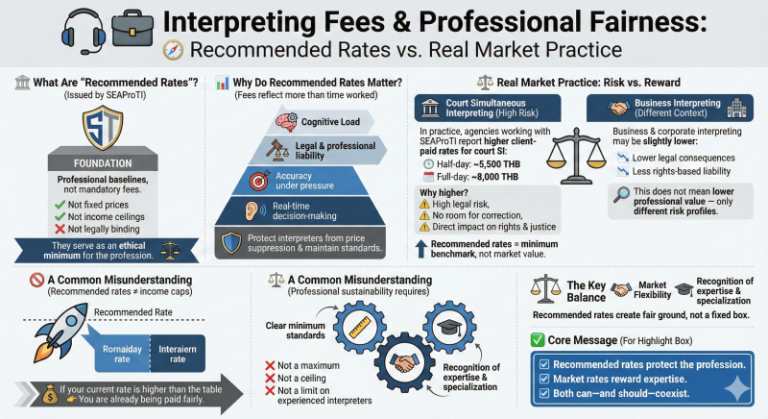
The interpreting rates published by SEAProTI for 2026 are explicitly designated as recommended baseline rates, not mandatory fees or income caps. This approach aligns with international practices of establishing professional minimum rates, which function as labor protection mechanisms rather than instruments of market control (Pym, 2012).
These recommended rates reflect skill acquisition costs, cognitive load, and professional liability exposure inherent in interpreting, rather than being calculated solely on an hourly basis.
Market Practice: The Case of Court-Based Simultaneous Interpreting
Empirical observations from agencies collaborating with SEAProTI indicate that actual client-paid rates for court-based simultaneous interpreting frequently exceed the recommended baseline. Typical remuneration includes:
- Approximately 5,500 THB for half-day assignments
- Approximately 8,000 THB for full-day assignments
These figures reflect the distinctive nature of court interpreting, which involves high cognitive stress, immediate legal consequences, and minimal tolerance for error. In such contexts, the recommended rate serves as a minimum ethical benchmark, not a representation of prevailing market value (Hale, 2007).
Differentiating Court Interpreting and Business Interpreting
By contrast, interpreting in business and corporate settings may command slightly lower rates. This difference does not imply inferior professional value but rather reflects differing levels of legal risk, liability, and rights-related consequences (Gentile, Ozolins, & Vasilakakos, 1996).
Applying uniform rates across fundamentally different interpreting contexts risks unfairness to both interpreters and clients. Market flexibility is therefore essential, provided it operates within clearly defined professional minimum standards.
Recommended Rates and Professional Fairness
A critical point is that SEAProTI’s recommended rates must not be interpreted as income ceilings. Interpreters who already command higher fees due to experience, specialization, or rare language combinations should be understood as receiving fair and appropriate compensation.
Structurally, recommended rates serve to:
- Protect interpreters from price undercutting
- Establish shared expectations with agencies and clients
- Enhance the professional status of interpreters within the labor system
Conclusion
This article argues that interpreting fees should not be treated as fixed numericalvalues butt as professional policy instruments designed to balance fairness, standards, and market flexibility. SEAProTI’s recommended rates function as an ethical baseline that safeguards interpreters without restricting income growth based on competence, specialization, or contextual demand.
References
- Gentile, A., Ozolins, U., & Vasilakakos, M. (1996). Liaison interpreting: A handbook. Melbourne, Australia: Melbourne University Press.
- Hale, S. (2007). Community interpreting. Basingstoke, England: Palgrave Macmillan.
https://doi.org/10.1057/9780230593442 - Pym, A. (2012). On translator ethics: Principles for mediation between cultures. Amsterdam, Netherlands: John Benjamins.
https://doi.org/10.1075/btl.104
About Certified Translators, Translation Certifiers, and Certified Interpreters of SEAProTI
The Southeast Asian Association of Professional Translators and Interpreters (SEAProTI) has formally announced the qualifications and requirements for registration of Certified Translators, Translation Certification Providers, and Certified Interpreters in Sections 9 and 10 of the Royal Gazette, published by the Secretariat of the Cabinet, Office of the Prime Minister of Thailand, on 25 July 2024 (Vol. 141, Part 66 Ng, p. 100). Certified Translators, Translation Certification Providers, and Certified Interpreters
The Council of State has proposed the enactment of a Royal Decree, granting registered translators and recognised translation certifiers from professional associations or accredited language institutions the authority to provide legally valid translation certification (Letter to SEAProTI dated April 28, 2025)
SEAProTI is the first professional association in Thailand and Southeast Asia to implement a comprehensive certification system for translators, certifiers, and interpreters.
Head Office: Baan Ratchakru Building, No. 33, Room 402, Soi Phahonyothin 5, Phahonyothin Road, Phaya Thai District, Bangkok 10400, Thailand
Email: hello@seaproti.com | Tel.: (+66) 2-114-3128 (Office hours: Mon–Fri, 09:00–17:00)
อัตราค่าจ้างล่ามในฐานะกลไกเชิงโครงสร้างของความเป็นธรรมทางวิชาชีพ: กรณีศึกษาเรทแนะนำของ SEAProTI และการปฏิบัติในตลาดแรงงานจริง
4 มกราคม 2569: 2569, กรุงเทพมหานคร – บทความนี้มุ่งวิเคราะห์บทบาทของอัตราค่าจ้างล่ามในฐานะกลไกเชิงโครงสร้างที่สะท้อนความเป็นธรรมทางวิชาชีพ โดยใช้กรณีศึกษาอัตราค่าจ้างล่าม “เรทแนะนำ” สำหรับปี พ.ศ. 2569 ที่จัดทำโดย SEAProTI เปรียบเทียบกับอัตราค่าจ้างที่เกิดขึ้นจริงในตลาด โดยเฉพาะงานล่ามพูดพร้อมในศาลและงานล่ามภาคธุรกิจ บทความเสนอว่า เรทแนะนำมิได้มีสถานะเป็นเพดานรายได้ หากแต่เป็น baseline เชิงจริยธรรมและแรงงานที่ช่วยคุ้มครองล่ามจากการถูกกดราคา พร้อมทั้งชี้ให้เห็นความจำเป็นของความยืดหยุ่นเชิงตลาดบนพื้นฐานของมาตรฐานวิชาชีพ
คำสำคัญ: อัตราค่าจ้างล่าม, ความเป็นธรรมทางวิชาชีพ, ล่ามศาล, ล่ามพูดพร้อม, มาตรฐานแรงงาน
บทนำ
อัตราค่าจ้างในวิชาชีพล่ามิได้เป็นเพียงประเด็นเชิงเศรษฐกิจ หากแต่เป็นองค์ประกอบสำคัญของโครงสร้างวิชาชีพที่สะท้อนความรับผิด ความเสี่ยง และสถานะของแรงงานทักษะสูง (high-skilled labor) ในสังคม งานล่าม โดยเฉพาะล่ามพูดพร้อม (simultaneous interpreting) และล่ามในกระบวนการยุติธรรม มีผลกระทบต่อสิทธิ เสรีภาพ และผลทางกฎหมายของผู้มีส่วนได้เสียโดยตรง ความคลุมเครือของเรทค่าจ้างจึงอาจนำไปสู่การกดค่าแรงและการบั่นทอนคุณภาพวิชาชีพในระยะยาว
แนวคิด “เรทแนะนำ” กับสถานะเชิงนโยบายวิชาชีพ
อัตราค่าจ้างล่ามที่ SEAProTI เผยแพร่สำหรับปี พ.ศ. 2569 ถูกกำหนดให้มีสถานะเป็น “เรทแนะนำ (recommended baseline)” มิใช่อัตราบังคับหรือเพดานสูงสุด แนวคิดดังกล่าวสอดคล้องกับหลักการกำหนดค่าแรงขั้นต่ำเชิงวิชาชีพ (professional minimum rates) ที่ใช้ในหลายประเทศ เพื่อทำหน้าที่เป็นเครื่องมือคุ้มครองแรงงาน มากกว่าการควบคุมตลาด (Pym, 2012)
เรทแนะนำดังกล่าวสะท้อนต้นทุนทางทักษะ (skill cost), ความเครียดทางปัญญา (cognitive load), และความเสี่ยงเชิงความรับผิด (liability exposure) ของงานล่าม มากกว่าการคำนวณจากชั่วโมงทำงานเพียงอย่างเดียว
การปฏิบัติจริงในตลาด: กรณีล่ามพูดพร้อมในศาล
จากข้อมูลการทำงานร่วมกับเอเจนซี่ที่ SEAProTI ติดต่อประสานงาน พบว่า อัตราที่ลูกค้าจ่ายจริงสำหรับล่ามพูดพร้อมในศาลมักสูงกว่าเรตแนะนำในตาราง ล่ามพูดพร้อมในศาล มักสูงกว่าเรทแนะนำในตาราง กล่าวคือ
- งานครึ่งวัน งานครึ่งวันอยู่ที่ประมาณ 5,500 บาท
- งานเต็มวัน อยู่ที่ประมาณ 8,000 บาท
อัตราดังกล่าวสะท้อนลักษณะเฉพาะของงานศาล ซึ่งมีแรงกดดันสูง ความผิดพลาดมีผลทางกฎหมายโดยตรง และล่ามต้องรับผิดชอบต่อความถูกต้องของถ้อยคำในบริบทที่ไม่สามารถแก้ไขย้อนหลังได้ (Hale, 2007) ในกรณีนี้ เรทแนะนำจึงทำหน้าที่เป็น “พื้นฐานขั้นต่ำ” มิใช่ค่าจ้างที่แท้จริงของตลาด
ความแตกต่างระหว่างงานล่ามศาลและล่ามภาคธุรกิจ
เมื่อเปรียบเทียบกับงานล่ามในภาคธุรกิจและองค์กรเอกชน พบว่าอัตราค่าจ้างอาจต่ำกว่างานศาลเล็กน้อย ความแตกต่างนี้มิได้สะท้อนคุณค่าของงานที่สูงหรือต่ำกว่า หากแต่เป็นผลจากระดับความเสี่ยงทางกฎหมาย ความผูกพันเชิงสิทธิ และผลกระทบของถ้อยคำที่แตกต่างกัน (Gentile, Ozolins, & Vasilakakos, 1996)
การกำหนดเรทเดียวกันโดยไม่คำนึงถึงบริบทของงาน อาจนำไปสู่ความไม่เป็นธรรมทั้งต่อล่ามและนายจ้าง ดังนั้น ความยืดหยุ่นเชิงตลาดจึงเป็นสิ่งจำเป็น ภายใต้กรอบมาตรฐานขั้นต่ำที่ชัดเจน
เรทแนะนำกับความเป็นธรรมต่อวิชาชีพ
ประเด็นสำคัญคือ เรทแนะนำของ SEAProTI ไม่ควรถูกตีความว่าเป็นเพดานรายได้ หากล่ามท่านใดมีเรทที่สูงกว่านี้จากประสบการณ์ ความเชี่ยวชาญเฉพาะด้าน หรือคู่ภาษาที่มีความต้องการสูง ย่อมถือได้ว่าได้รับค่าตอบแทนที่ยุติธรรมกับงานที่ปฏิบัติอยู่แล้ว
ในเชิงโครงสร้าง เรทแนะนำทำหน้าที่
- คุ้มครองล่ามจากการถูกกดราคา
- สร้างความเข้าใจร่วมกับนายจ้างและเอเจนซี่
- ยกระดับสถานะของวิชาชีพล่ามในระบบแรงงาน
บทสรุป
บทความนี้เสนอว่า อัตราค่าจ้างล่ามไม่ควรถูกมองเป็นตัวเลขตายตัว หากแต่เป็นเครื่องมือเชิงนโยบายวิชาชีพที่ต้องสร้างสมดุลระหว่างความเป็นธรรม มาตรฐาน และความยืดหยุ่นของตลาด เรทแนะนำของ SEAProTI จึงมีบทบาทสำคัญในฐานะ baseline เชิงจริยธรรม ที่ช่วยคุ้มครองล่าม โดยไม่ปิดกั้นการเติบโตของรายได้ตามความสามารถและบริบทของงาน
เอกสารอ้างอิง (References)
- Gentile, A., Ozolins, U., & Vasilakakos, M. (1996). Liaison interpreting: A handbook. Melbourne: Melbourne University Press.
- Hale, S. (2007). Community interpreting. Basingstoke: Palgrave Macmillan.
https://doi.org/10.1057/9780230593442 - Pym, A. (2012). On translator ethics: Principles for mediation between cultures. Amsterdam: John Benjamins.
https://doi.org/10.1075/btl.104
เกี่ยวกับนักแปลรับรอง ผู้รับรองการแปล และล่ามรับรองของสมาคมวิชาชีพนักแปลและล่ามแห่งเอเชียตะวันออกเฉียงใต้
สมาคมวิชาชีพนักแปลและล่ามแห่งเอเชียตะวันออกเฉียงใต้ (SEAProTI) ได้ประกาศหลักเกณฑ์และคุณสมบัติผู้ที่ขึ้นทะเบียนเป็น “นักแปลรับรอง (Certified Translators) และผู้รับรองการแปล (Translation Certification Providers) และล่ามรับรอง (Certified Interpreters)” ของสมาคม หมวดที่ 9 และหมวดที่ 10 ในราชกิจจานุเบกษา ของสำนักเลขาธิการคณะรัฐมนตรี ในสำนักนายกรัฐมนตรี แห่งราชอาณาจักรไทย ลงวันที่ 25 ก.ค. 2567 เล่มที่ 141 ตอนที่ 66 ง หน้า 100 อ่านฉบับเต็มได้ที่: นักแปลรับรอง ผู้รับรองการแปล และล่ามรับรอง
สำนักคณะกรรมการกฤษฎีกา เสนอให้ตราเป็นพระราชกฤษฎีกา โดยกำหนดให้นักแปลที่ขึ้นทะเบียน รวมถึงผู้รับรองการแปลจากสมาคมวิชาชีพหรือสถาบันสอนภาษาที่มีการอบรมและขึ้นทะเบียน สามารถรับรองคำแปลได้ (จดหมายถึงสมาคม SEAProTI ลงวันที่ 28 เม.ย. 2568)
สมาคมวิชาชีพนักแปลและล่ามแห่งเอเชียตะวันออกเฉียงใต้ เป็นสมาคมวิชาชีพแห่งแรกและแห่งเดียวในประเทศไทยและภูมิภาคเอเชียตะวันออกเฉียงใต้ที่มีระบบรับรองนักแปลรับรอง ผู้รับรองการแปล และล่ามรับรอง
สำนักงานใหญ่: อาคารบ้านราชครู เลขที่ 33 ห้อง 402 ซอยพหลโยธิน 5 ถนนพหลโยธิน แขวงพญาไท เขตพญาไท กรุงเทพมหานคร 10400 ประเทศไทย
อีเมล: hello@seaproti.com โทรศัพท์: (+66) 2-114-3128 (เวลาทำการ: วันจันทร์–วันศุกร์ เวลา 09.00–17.00 น.