



From Stigmatization to the Institutionalization of Professional Standards
The Evolution of the Southeast Asian Association of Professional Translators and Interpreters (SEAProTI) in Its First Five Years
4 December 2025, Bangkok — This article analyses the development of the Southeast Asian Association of Professional Translators and Interpreters (SEAProTI) during the first five years of its establishment. It focuses on the process of legitimacy construction undertaken by a newly formed professional organisation amid resistance from entrenched power structures, internal professional conflicts, and opposition from incumbent interest groups. The article argues that SEAProTI’s trajectory reflects a classic pattern of professional self-regulation emerging in a social context that has historically lacked systematic mechanisms for language-standard governance.
Keywords: translation and interpreting profession; professional self-regulation; legitimacy; professional standards; SEAProTI
Introduction
Translation and interpreting are activities directly implicated in the administration of justice, healthcare delivery, and interstate relations. In the Thai context, however, the profession has long existed in a “semi-professional” state, characterised by the absence of formal credentialing mechanisms and systematic ethical oversight. The establishment of SEAProTI was therefore not merely a voluntary association of practitioners, but an attempt to construct a professional institution grounded in actual practice and held accountable to established standards.
From Stigmatisation and Threats: The Context of Resistance
In its early phase, SEAProTI faced intense disparagement from senior figures within the profession, who perceived the new organisation as “upstarts unaware of their place” or as a threat to existing patronage-based arrangements. In some cases, this hostility escalated into intimidation, threats, and efforts to undermine the credibility of the association’s founders and committee members.
This pattern aligns with Abbott’s (1988) observation that challenges to professional jurisdiction are often met not through substantive debates over standards or quality, but through the defence of symbolic authority and entrenched status.
Years 1–2: Structural Formation and Institutional Gatekeeping
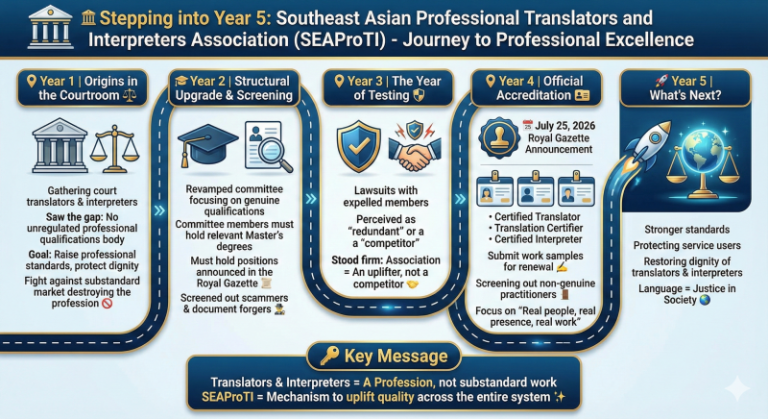
SEAProTI originated among court translators and interpreters who had firsthand experience with the consequences of unregulated language services within the justice system. The restructuring of the executive committee in the second year—introducing requirements regarding academic qualifications, professional positions, and transparency in appointments—served as a crucial mechanism for building institutional capital.
The systematic exclusion of individuals who falsified credentials or sought to exploit the association for personal gain demonstrates an explicit effort to separate membership from popularity and to affirm professional virtue and accountability (Freidson, 2001).
Year 3: Conflict, Litigation, and the Test of Legitimacy
The third year marked a critical test for SEAProTI, as the association faced legal action from expelled members and accusations of being a “competitor to the state.” This article contends that such conflicts did not signify organisational failure; rather, they indicated a transition from a volunteer-based collective to a professional institution exercising normative authority over standards and conduct.
Year 4: Official Registers and Practice-Based Regulation
The publication in the Royal Gazette on 25 July 2025 of official registers for certified translators, translation certifiers, and certified interpreters constituted a structural milestone. The introduction of mandatory work-sample submission for license renewal, coupled with the removal of individuals not actively practicing, marked a shift from symbolic recognition to quality-based regulation grounded in demonstrable professional activity.
Year 5 and Beyond: The Profession as a Public Institution
Entering its fifth year, SEAProTI no longer confronts questions of mere survival. Instead, it faces ethical and policy-oriented questions concerning how professional certification can protect both practitioners and the public. The lessons of the first five years suggest that a sustainable profession cannot rely on inherited prestige or entrenched authority but must be built upon mechanisms of scrutiny, transparency, and the willingness to exclude those who fail to meet established standards.
Conclusion
From a period marked by stigmatisation, intimidation, and persistent challenges to its legitimacy, SEAProTI has evolved into a professional institution with a defined structure, regulatory mechanisms, and normative authority. This case study illustrates that the professionalisation of translation and interpreting in Thailand cannot avoid conflict; rather, such conflict constitutes a necessary condition for transition toward genuine and enforceable standards.
References
- Abbott, A. (1988). The system of professions: An essay on the division of expert labour. University of Chicago Press.
- Bourdieu, P. (1991). Language and symbolic power. Harvard University Press.
- Freidson, E. (2001). Professionalism: The third logic. University of Chicago Press.
- Mikkelson, H. (2014). Introduction to court interpreting (2nd ed.). Routledge.
- Pym, A. (2012). On translator ethics: Principles for mediation between cultures. John Benjamins.
About Certified Translators, Translation Certifiers, and Certified Interpreters of SEAProTI
The Southeast Asian Association of Professional Translators and Interpreters (SEAProTI) has formally announced the qualifications and requirements for registration of Certified Translators, Translation Certification Providers, and Certified Interpreters in Sections 9 and 10 of the Royal Gazette, published by the Secretariat of the Cabinet, Office of the Prime Minister of Thailand, on 25 July 2024 (Vol. 141, Part 66 Ng, p. 100). Certified Translators, Translation Certification Providers, and Certified Interpreters
The Council of State has proposed the enactment of a Royal Decree, granting registered translators and recognised translation certifiers from professional associations or accredited language institutions the authority to provide legally valid translation certification (Letter to SEAProTI dated April 28, 2025)
SEAProTI is the first professional association in Thailand and Southeast Asia to implement a comprehensive certification system for translators, certifiers, and interpreters.
Head Office: Baan Ratchakru Building, No. 33, Room 402, Soi Phahonyothin 5, Phahonyothin Road, Phaya Thai District, Bangkok 10400, Thailand
Email: hello@seaproti.com | Tel.: (+66) 2-114-3128 (Office hours: Mon–Fri, 09:00–17:00)
จากการถูกปรามาสสู่การสถาปนามาตรฐานวิชาชีพ
วิวัฒนาการของ สมาคมวิชาชีพนักแปลและล่ามแห่งเอเชียตะวันออกเฉียงใต้ ในช่วงห้าปีแรก
4 ธันวาคม 2568, กรุงเทพมหานคร – บทความนี้วิเคราะห์พัฒนาการของสมาคมวิชาชีพนักแปลและล่ามแห่งเอเชียตะวันออกเฉียงใต้ (SEAProTI) ในช่วงห้าปีแรกของการก่อตั้ง โดยมุ่งอธิบายกระบวนการสถาปนาความชอบธรรม (legitimacy construction) ขององค์กรวิชาชีพใหม่ ท่ามกลางแรงต้านจากโครงสร้างอำนาจเดิม ความขัดแย้งภายในวิชาชีพ และการต่อต้านจากกลุ่มผู้มีผลประโยชน์เดิม บทความเสนอว่า เส้นทางของ SEAProTI สะท้อนรูปแบบคลาสสิกของการเกิด “professional self-regulation” ในสังคมที่ยังขาดกลไกกำกับมาตรฐานด้านภาษาอย่างเป็นระบบ
คำสำคัญ: วิชาชีพนักแปลและล่าม, การกำกับตนเองทางวิชาชีพ, ความชอบธรรม, มาตรฐานวิชาชีพ, SEAProTI
บทนำ
การแปลและการล่ามเป็นกิจกรรมที่เกี่ยวข้องโดยตรงกับกระบวนการยุติธรรม การแพทย์ และความสัมพันธ์ระหว่างรัฐ อย่างไรก็ตาม ในบริบทสังคมไทย วิชาชีพนักแปลและล่ามกลับดำรงอยู่ในสภาพ “กึ่งวิชาชีพ” (semi-profession) ที่ขาดกลไกการรับรองคุณวุฒิและการกำกับจริยธรรมอย่างเป็นระบบ การก่อตั้ง SEAProTI จึงมิได้เป็นเพียงการรวมกลุ่มเชิงสมัครใจ แต่เป็นความพยายามสร้างสถาบันวิชาชีพขึ้นใหม่จากฐานปฏิบัติจริง
จากวันที่ถูกปรามาสและอาฆาตมาดร้าย: บริบทของการต่อต้าน
ในระยะแรกของการก่อตั้ง SEAProTI เผชิญกับการปรามาสอย่างรุนแรงจากผู้มีบทบาทในวิชาชีพรุ่นก่อน ซึ่งมองว่าองค์กรใหม่เป็น “เด็กใหม่ที่ไม่รู้ที่ต่ำที่สูง” หรือเป็นภัยต่อระบบอุปถัมภ์เดิม บางกรณีลุกลามถึงการข่มขู่ อาฆาตมาดร้าย และการพยายามบ่อนทำลายความน่าเชื่อถือของกรรมการและสมาชิกผู้ก่อตั้ง
ปรากฏการณ์ดังกล่าวสอดคล้องกับงานของ Abbott (1988) ที่ชี้ว่า เมื่อเกิดการท้าทายเขตอำนาจทางวิชาชีพ (professional jurisdiction) กลุ่มเดิมมักตอบโต้ด้วยการปกป้องอำนาจเชิงสัญลักษณ์ มากกว่าการถกเถียงเชิงมาตรฐานหรือคุณภาพ
ปีที่ 1–2: การสถาปนาโครงสร้างและการคัดกรองเชิงสถาบัน
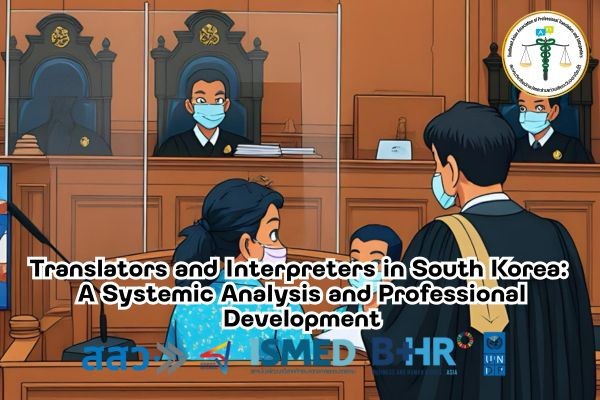
SEAProTI เริ่มต้นจากกลุ่มนักแปลและล่ามในห้องพิจารณาคดี ซึ่งประสบปัญหาความไร้มาตรฐานของผู้ปฏิบัติงานในระบบยุติธรรม การปรับโครงสร้างคณะกรรมการในปีที่สอง โดยกำหนดคุณสมบัติด้านการศึกษา ตำแหน่งหน้าที่ และความโปร่งใสในการแต่งตั้ง เป็นกลไกสำคัญในการสร้างทุนทางสถาบัน (institutional capital)
การคัดกรองบุคคลที่แอบอ้างคุณวุฒิหรือใช้สมาคมเป็นเครื่องมือแสวงหาผลประโยชน์ส่วนตน แสดงให้เห็นความพยายามแยก “สมาชิกภาพ” ออกจาก “ความนิยม” และยืนยันหลักคุณธรรมทางวิชาชีพ (Freidson, 2001)
ปีที่ 3: ความขัดแย้ง คดีความ และการทดสอบความชอบธรรม
การถูกฟ้องร้องจากผู้ถูกขับออกจากสมาคม และการถูกกล่าวหาว่าเป็น “คู่แข่งของรัฐ” เป็นบททดสอบสำคัญของ SEAProTI ในปีที่สาม บทความนี้เสนอว่า ความขัดแย้งดังกล่าวไม่ใช่ความล้มเหลว แต่เป็นสัญญาณของการเปลี่ยนผ่านจากกลุ่มอาสาสมัครสู่สถาบันวิชาชีพที่มีอำนาจเชิงบรรทัดฐาน (normative authority)
ปีที่ 4: การขึ้นบัญชีและการกำกับมาตรฐานเชิงปฏิบัติ
การประกาศขึ้นบัญชีนักแปลรับรอง ผู้รับรองการแปล และล่ามรับรองในราชกิจจานุเบกษาเมื่อวันที่ 25 กรกฎาคม 2568 ถือเป็นหมุดหมายเชิงโครงสร้าง การกำหนดให้มีการส่งตัวอย่างงานเพื่อต่ออายุ และการคัดออกผู้ที่ไม่ประกอบวิชาชีพจริง เป็นการยกระดับจาก “การรับรองเชิงสัญลักษณ์” สู่ “การกำกับคุณภาพเชิงปฏิบัติ” (quality-based regulation)
ปีที่ 5 และอนาคต: วิชาชีพในฐานะสถาบันสาธารณะ
เมื่อก้าวเข้าสู่ปีที่ห้า SEAProTI ไม่ได้เผชิญคำถามเรื่องการอยู่รอดอีกต่อไป แต่เผชิญคำถามเชิงจริยธรรมและนโยบายว่า จะทำอย่างไรให้การรับรองวิชาชีพคุ้มครองทั้งผู้ปฏิบัติงานและสาธารณชน บทเรียนจากห้าปีแรกชี้ว่า วิชาชีพที่ยั่งยืนไม่อาจตั้งอยู่บนชื่อเสียงหรืออำนาจเดิม แต่ต้องตั้งอยู่บนกลไกตรวจสอบ ความโปร่งใส และความกล้าที่จะตัดคนที่ไม่ผ่านมาตรฐานออกจากระบบ
บทสรุป
จากวันที่ถูกปรามาส อาฆาตมาดร้าย และถูกตั้งคำถามถึงความชอบธรรม SEAProTI ได้พัฒนาเป็นสถาบันวิชาชีพที่มีโครงสร้าง กลไก และอำนาจเชิงมาตรฐานที่ชัดเจน กรณีศึกษานี้สะท้อนให้เห็นว่า การยกระดับวิชาชีพในสังคมไทยไม่อาจหลีกเลี่ยงความขัดแย้ง แต่ความขัดแย้งนั้นเองคือเงื่อนไขของการเปลี่ยนผ่านสู่มาตรฐานที่แท้จริง
เอกสารอ้างอิง
- Abbott, A. (1988). The system of professions: An essay on the division of expert labor. University of Chicago Press.
- Bourdieu, P. (1991). Language and symbolic power. Harvard University Press.
- Freidson, E. (2001). Professionalism: The third logic. University of Chicago Press.
- Mikkelson, H. (2014). Introduction to court interpreting (2nd ed.). Routledge.
- Pym, A. (2012). On translator ethics: Principles for mediation between cultures. John Benjamins.
เกี่ยวกับนักแปลรับรอง ผู้รับรองการแปล และล่ามรับรองของสมาคมวิชาชีพนักแปลและล่ามแห่งเอเชียตะวันออกเฉียงใต้
สมาคมวิชาชีพนักแปลและล่ามแห่งเอเชียตะวันออกเฉียงใต้ (SEAProTI) ได้ประกาศหลักเกณฑ์และคุณสมบัติผู้ที่ขึ้นทะเบียนเป็น “นักแปลรับรอง (Certified Translators) และผู้รับรองการแปล (Translation Certification Providers) และล่ามรับรอง (Certified Interpreters)” ของสมาคม หมวดที่ 9 และหมวดที่ 10 ในราชกิจจานุเบกษา ของสำนักเลขาธิการคณะรัฐมนตรี ในสำนักนายกรัฐมนตรี แห่งราชอาณาจักรไทย ลงวันที่ 25 ก.ค. 2567 เล่มที่ 141 ตอนที่ 66 ง หน้า 100 อ่านฉบับเต็มได้ที่: นักแปลรับรอง ผู้รับรองการแปล และล่ามรับรอง
สำนักคณะกรรมการกฤษฎีกา เสนอให้ตราเป็นพระราชกฤษฎีกา โดยกำหนดให้นักแปลที่ขึ้นทะเบียน รวมถึงผู้รับรองการแปลจากสมาคมวิชาชีพหรือสถาบันสอนภาษาที่มีการอบรมและขึ้นทะเบียน สามารถรับรองคำแปลได้ (จดหมายถึงสมาคม SEAProTI ลงวันที่ 28 เม.ย. 2568)
สมาคมวิชาชีพนักแปลและล่ามแห่งเอเชียตะวันออกเฉียงใต้ เป็นสมาคมวิชาชีพแห่งแรกและแห่งเดียวในประเทศไทยและภูมิภาคเอเชียตะวันออกเฉียงใต้ที่มีระบบรับรองนักแปลรับรอง ผู้รับรองการแปล และล่ามรับรอง
สำนักงานใหญ่: อาคารบ้านราชครู เลขที่ 33 ห้อง 402 ซอยพหลโยธิน 5 ถนนพหลโยธิน แขวงพญาไท เขตพญาไท กรุงเทพมหานคร 10400 ประเทศไทย
อีเมล: hello@seaproti.com โทรศัพท์: (+66) 2-114-3128 (เวลาทำการ: วันจันทร์–วันศุกร์ เวลา 09.00–17.00 น.