


Forensic Linguistics in Thailand: From Independent Experts to Emerging Commercial Opportunities
22 March 2026, Bangkok — In recent years, forensic linguistics has begun to play an increasingly visible role in Thailand’s justice system, both in criminal and civil cases. Its application is particularly evident in cases where language itself constitutes key evidence such as threat analysis, contract interpretation, and authorship attribution.
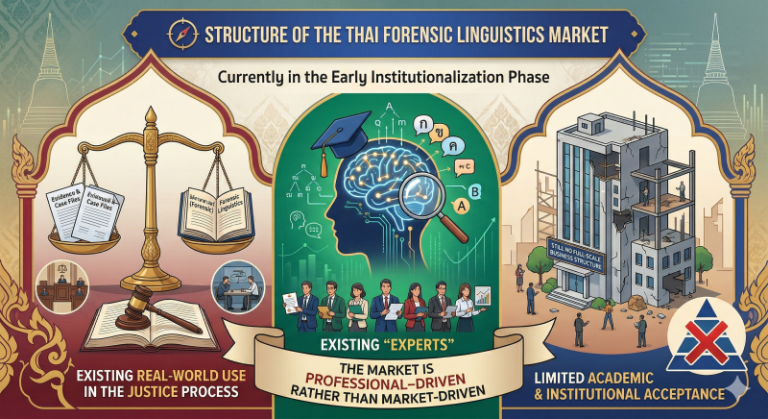
However, when examined from the perspective of market structure and service delivery, Thailand remains in an early stage of professionalization, rather than operating as a fully developed professional services industry, as seen in many Western countries.
Current Structure: A Professional-Driven Market
A defining characteristic of forensic linguistics in Thailand is its reliance on independent experts, rather than specialized commercial firms.
These experts typically serve in roles such as the following:
- Expert witnesses in court
- Case consultants for lawyers and government agencies
- Language analysts in specific disputes, including commercial litigation and defamation cases
Although such services carry clear economic value and are compensated accordingly, they are not yet embedded within structured business entities with dedicated teams, client management systems, or marketing frameworks.
The Role of Professional Organizations: Building Institutional Foundations
In this context, the Southeast Asian Association of Professional Translators and Interpreters has emerged as a key institutional actor in shaping the development of forensic linguistics in Thailand.
Its core contributions include the following:
- Registering forensic linguistics experts
- Establishing professional standards and guidelines
- Facilitating networks among linguists, translators, interpreters, and legal professionals
These efforts represent an important step toward institutionalization, enhancing credibility in the eyes of courts and service users alike.
Nature of Work: Commercial but Not Yet a Service Business
While forensic linguistics services in Thailand are undeniably commercial in nature, they remain structurally informal—what may be described as “commercial activity without commercial infrastructure.”
Common types of work include:
- Linguistic analysis in defamation cases
- Identifying ambiguity in contractual language
- Examining witness statements and confessions
- Authorship attribution of disputed texts
- Evaluating language use in trademark and advertising disputes
These activities demonstrate that demand exists, yet it has not been systematically organized into a formalized service market.
International Comparison: From Profession to Industry
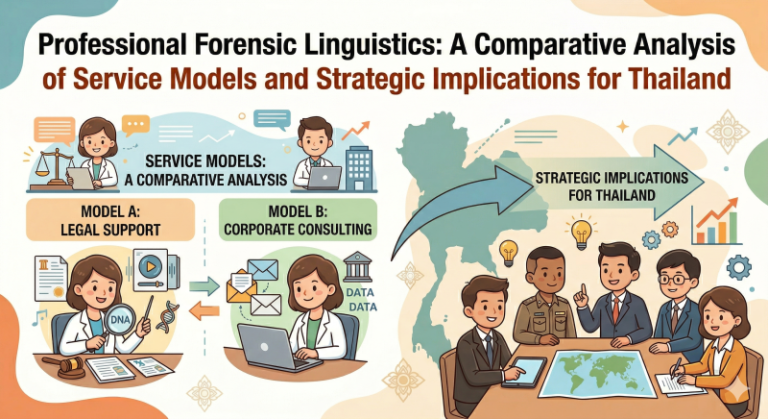
In contrast, forensic linguistics in many Western countries has evolved into a professional services industry, with dedicated firms offering structured, fee-based services.
Key characteristics of these models include:
- Established companies with full-time teams
- Services spanning legal, corporate, and intelligence sectors
- Brand development and client acquisition strategies
- High-volume, diversified casework
This transformation positions forensic linguistics alongside other professional services such as law, auditing, and consulting.
The Opportunity Gap: When Demand Remains Invisible
A critical issue in Thailand is the presence of hidden demand. Many cases could benefit from forensic linguistic analysis, yet stakeholders often:
- Are unaware of the discipline
- Do not know how to access qualified experts
- Rely on individuals without specialized expertise
This gap highlights the need for market education, alongside the continued development of professional standards.
Future Outlook: From Individuals to Organized Practice
The trajectory of forensic linguistics in Thailand may evolve in three phases:
- Short term: Continued reliance on individual experts
- Medium term: Emergence of collaborative groups or boutique firms
- Long term: Development of fully established forensic linguistics companies, integrated with law firms and investigative services
Key drivers of this transition include:
- Judicial recognition of expert testimony
- Formalization of professional standards
- Increased awareness and demand within the market
Conclusion
Forensic linguistics in Thailand is not absent—it is pre-industrial in structure. The country already possesses the necessary expertise, knowledge base, and real-world applications. What remains underdeveloped is the organizational and commercial framework to support it at scale.
At present, the most effective way to access forensic linguistics services is through professional bodies such as the Southeast Asian Association of Professional Translators and Interpreters, which can provide guidance and connect clients with suitable experts.
Looking ahead, with sustained development, forensic linguistics has the potential to become a strategic professional service, playing a vital role not only in the justice system but also across Thailand’s broader legal and business sectors
For professional services, please visit: https://www.seaproti.org/practitioners/
About certified translators, translation certifiers, and certified interpreters associated with SEAProTI.
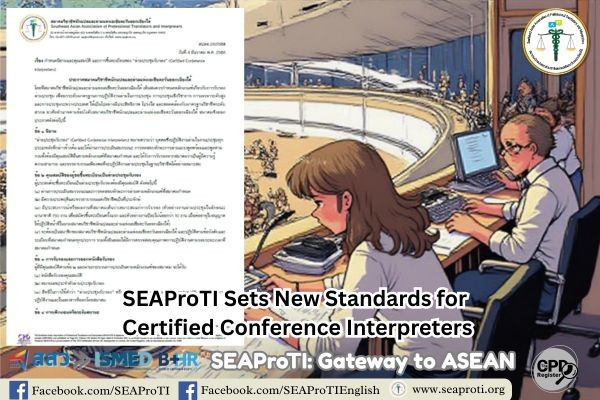
The Southeast Asian Association of Professional Translators and Interpreters (SEAProTI) has officially shared the qualifications and requirements for becoming Certified Translators, Translation Certification Providers, and Certified Interpreters in Sections 9 and 10 of the Royal Gazette, which was published by the Prime Minister’s Office in Thailand on July 25, 2024. Certified Translators, Translation Certification Providers, and Certified Interpreters
The Council of State has proposed the enactment of a Royal Decree, granting registered translators and recognised translation certifiers from professional associations or accredited language institutions the authority to provide legally valid translation certification (Letter to SEAProTI dated April 28, 2025)
SEAProTI is the first professional association in Thailand and Southeast Asia to implement a comprehensive certification system for translators, certifiers, and interpreters.
Head Office: Baan Ratchakru Building, No. 33, Room 402, Soi Phahonyothin 5, Phahonyothin Road, Phaya Thai District, Bangkok 10400, Thailand
Email: hello@seaproti.com | Tel.: (+66) 2-114-3128 (Office hours: Mon–Fri, 09:00–17:00).
นิติภาษาศาสตร์ในประเทศไทย: จากผู้เชี่ยวชาญอิสระสู่โอกาสเชิงธุรกิจในอนาคต
22 มีนาคม 2569, กรุงเทพมหานคร – ในช่วงไม่กี่ปีที่ผ่านมา “นิติภาษาศาสตร์” (Forensic Linguistics) ได้เริ่มมีบทบาทชัดเจนมากขึ้นในกระบวนการยุติธรรมของประเทศไทย ทั้งในคดีอาญาและคดีแพ่ง โดยเฉพาะคดีที่เกี่ยวข้องกับ “ภาษา” ในฐานะพยานหลักฐาน เช่น การวิเคราะห์คำขู่ การตีความสัญญา หรือการพิสูจน์ผู้เขียน (authorship analysis)
อย่างไรก็ตาม หากพิจารณาในเชิงโครงสร้างตลาดและรูปแบบการให้บริการ จะพบว่าประเทศไทยยังอยู่ใน “ระยะเริ่มต้นของการพัฒนาเชิงวิชาชีพ” (early-stage professionalization) มากกว่าการเป็น “อุตสาหกรรมบริการเต็มรูปแบบ” ดังเช่นในหลายประเทศตะวันตก
โครงสร้างปัจจุบัน: วิชาชีพนำตลาด (Professional-driven Market)
ลักษณะเด่นของนิติภาษาศาสตร์ในประเทศไทย คือการดำเนินงานผ่าน “ผู้เชี่ยวชาญอิสระ” (independent experts) เป็นหลัก มากกว่าการจัดตั้งเป็นบริษัทเอกชนเฉพาะทาง
ผู้เชี่ยวชาญเหล่านี้มักทำงานในบทบาท:
- พยานผู้เชี่ยวชาญในศาล (expert witness)
- ที่ปรึกษาคดีให้กับทนายความหรือหน่วยงานรัฐ
- ผู้วิเคราะห์ภาษาในกรณีเฉพาะ เช่น ข้อพิพาททางการค้า หรือคดีหมิ่นประมาท
การให้บริการดังกล่าวแม้จะมี “มูลค่าทางเศรษฐกิจ” และสามารถเรียกค่าตอบแทนได้ แต่ยังไม่อยู่ในรูปแบบของ “องค์กรธุรกิจ” ที่มีโครงสร้างทีม การบริหารลูกค้า และการตลาดอย่างเป็นระบบ
บทบาทขององค์กรวิชาชีพ: การวางรากฐานของระบบ
ในบริบทนี้ สมาคมวิชาชีพนักแปลและล่ามแห่งเอเชียตะวันออกเฉียงใต้ ได้เข้ามามีบทบาทสำคัญในฐานะ “องค์กรกลาง” ที่เริ่มพัฒนาโครงสร้างของวิชาชีพนิติภาษาศาสตร์ในประเทศไทย
บทบาทสำคัญ ได้แก่:
- การขึ้นทะเบียนผู้เชี่ยวชาญด้านนิติภาษาศาสตร์
- การกำหนดแนวทางปฏิบัติทางวิชาชีพ
- การสร้างเครือข่ายระหว่างนักภาษาศาสตร์ นักแปล ล่าม และนักกฎหมาย
การดำเนินงานดังกล่าวถือเป็น “ก้าวแรกของ institutionalization” ซึ่งมีความสำคัญอย่างยิ่งต่อการสร้างความน่าเชื่อถือในสายตาของศาลและผู้ใช้บริการ
ลักษณะงาน: เชิงพาณิชย์แต่ยังไม่เป็นอุตสาหกรรม
แม้ว่าการให้บริการนิติภาษาศาสตร์ในไทยจะสามารถสร้างรายได้ แต่ลักษณะงานยังคงเป็น “commercial activity without commercial structure” กล่าวคือ มีการว่าจ้างและค่าตอบแทน แต่ยังไม่มีโครงสร้างองค์กรรองรับ
ตัวอย่างงานที่พบได้ ได้แก่:
- การวิเคราะห์ถ้อยคำในคดีหมิ่นประมาท
- การตรวจสอบความกำกวมในสัญญา
- การวิเคราะห์คำให้การหรือคำรับสารภาพ
- การพิสูจน์ผู้เขียนเอกสาร
- การประเมินข้อความในคดีเครื่องหมายการค้าและโฆษณา
งานเหล่านี้สะท้อนว่า “ความต้องการมีอยู่จริง” แต่ยังไม่ได้ถูกจัดระบบให้กลายเป็นตลาดบริการอย่างเต็มรูปแบบ
การเปรียบเทียบกับต่างประเทศ: จากวิชาชีพสู่ธุรกิจบริการ
ในประเทศตะวันตก นิติภาษาศาสตร์ได้พัฒนาไปสู่รูปแบบ “ธุรกิจบริการวิชาชีพ” (professional services industry) แล้ว โดยมีบริษัทเฉพาะทางที่ให้บริการอย่างเป็นระบบ
ลักษณะสำคัญของโมเดลต่างประเทศ ได้แก่:
- มีบริษัทและทีมงานประจำ
- ให้บริการทั้งภาคกฎหมาย ธุรกิจ และความมั่นคง
- มีการสร้างแบรนด์และช่องทางลูกค้า
- รับงานในปริมาณมากและหลากหลายประเภท
โครงสร้างดังกล่าวทำให้นิติภาษาศาสตร์กลายเป็นส่วนหนึ่งของ ecosystem เดียวกับ law firms, audit firms และ consulting firms
ช่องว่างเชิงโอกาส: เมื่อ “ความต้องการ” ยังมองไม่เห็น
หนึ่งในประเด็นสำคัญของประเทศไทยคือ “อุปสงค์แฝง” (hidden demand) กล่าวคือ มีหลายกรณีที่ควรใช้บริการนิติภาษาศาสตร์ แต่ผู้เกี่ยวข้องยัง:
- ไม่ทราบว่ามีศาสตร์นี้
- ไม่ทราบวิธีเข้าถึงผู้เชี่ยวชาญ
- หรือใช้บุคคลที่ไม่มีความเชี่ยวชาญเฉพาะทาง
ช่องว่างดังกล่าวสะท้อนว่า ตลาดยังต้องการ “การให้ความรู้” (market education) ควบคู่ไปกับการพัฒนามาตรฐานวิชาชีพ
แนวโน้มในอนาคต: จากผู้เชี่ยวชาญสู่การรวมตัวเชิงธุรกิจ
ทิศทางในอนาคตของนิติภาษาศาสตร์ในประเทศไทยอาจพัฒนาเป็นลำดับดังนี้:
- ระยะสั้น: ยังคงเป็นตลาดที่ขับเคลื่อนโดยผู้เชี่ยวชาญรายบุคคล
- ระยะกลาง: เริ่มเกิดการรวมตัวเป็นกลุ่มหรือ boutique firm
- ระยะยาว: พัฒนาเป็นบริษัทเฉพาะทางที่เชื่อมโยงกับสำนักงานกฎหมายและองค์กรด้านการสืบสวน
ปัจจัยสำคัญที่จะผลักดันการเปลี่ยนผ่าน ได้แก่:
- การยอมรับของศาลต่อพยานผู้เชี่ยวชาญ
- การกำหนดมาตรฐานวิชาชีพ
- การสร้างความตระหนักรู้ในตลาด
บทสรุป
นิติภาษาศาสตร์ในประเทศไทยไม่ได้เป็นศาสตร์ที่ “ขาดหาย” หากแต่เป็นศาสตร์ที่ “ยังอยู่ในช่วงก่อนการพัฒนาเชิงอุตสาหกรรม” กล่าวคือ มีทั้งผู้เชี่ยวชาญ ความรู้ และการใช้งานจริง แต่ยังขาดโครงสร้างธุรกิจที่รองรับอย่างเป็นระบบ
ในบริบทปัจจุบัน การเข้าถึงบริการนิติภาษาศาสตร์ที่เหมาะสมที่สุด คือการติดต่อผ่านองค์กรวิชาชีพ เช่น สมาคมวิชาชีพนักแปลและล่ามแห่งเอเชียตะวันออกเฉียงใต้ เพื่อขอคำแนะนำและรายชื่อผู้เชี่ยวชาญที่เหมาะสมกับลักษณะของคดี
ท้ายที่สุด หากการพัฒนาดำเนินไปอย่างต่อเนื่อง นิติภาษาศาสตร์อาจกลายเป็นหนึ่งใน “บริการวิชาชีพเชิงกลยุทธ์” ที่มีบทบาทสำคัญทั้งในระบบยุติธรรมและภาคธุรกิจของประเทศไทยในอนาคตอันใกล้
ติดต่อขอใช้บริการนักวิชาชีพของสมาคมได้ที่: https://www.seaproti.org/practitioners/
- สมาคมวิชาชีพนักแปลและล่ามแห่งเอเชียตะวันออกเฉียงใต้ (SEAProTI) ได้ประกาศหลักเกณฑ์และคุณสมบัติของผู้ที่ขึ้นทะเบียนเป็น “นักแปลรับรอง (Certified Translators) และผู้รับรองการแปล (Translation Certification Providers) และล่ามรับรอง (Certified Interpreters)” ของสมาคม หมวดที่ 9 และหมวดที่ 10 ในราชกิจจานุเบกษา ของสำนักเลขาธิการคณะรัฐมนตรี ในสำนักนายกรัฐมนตรี แห่งราชอาณาจักรไทย ลงวันที่ 25 ก.ค. 2567 เล่มที่ 141 ตอนที่ 66 ง หน้า 100 อ่านฉบับเต็มได้ที่: นักแปลรับรอง ผู้รับรองการแปล และล่ามรับรอง
- สำนักคณะกรรมการกฤษฎีกาเสนอให้ตราเป็นพระราชกฤษฎีกา โดยกำหนดให้นักแปลที่ขึ้นทะเบียน รวมถึงผู้รับรองการแปลจากสมาคมวิชาชีพหรือสถาบันสอนภาษาที่มีการอบรมและขึ้นทะเบียน สามารถรับรองคำแปลได้ (จดหมายถึงสมาคม SEAProTI ลงวันที่ 28 เม.ย. 2568)
- สมาคมวิชาชีพนักแปลและล่ามแห่งเอเชียตะวันออกเฉียงใต้เป็นสมาคมวิชาชีพแห่งแรกและแห่งเดียวในประเทศไทยและภูมิภาคเอเชียตะวันออกเฉียงใต้ที่มีระบบรับรองนักแปลรับรอง ผู้รับรองการแปล และล่ามรับรอง
สำนักงานใหญ่: อาคารบ้านราชครู เลขที่ 33 ห้อง 402 ซอยพหลโยธิน 5 ถนนพหลโยธิน แขวงพญาไท เขตพญาไท กรุงเทพมหานคร 10400 ประเทศไทย
อีเมล: hello@seaproti.com โทรศัพท์: (+66) 2-114-3128 (เวลาทำการ: วันจันทร์–วันศุกร์ เวลา 09.00–17.00 น.