


An Analysis of Supreme Court Judgment No. 375/2019 from a Forensic Linguistics Perspective:
The Role of Language in Indictments and Communicative Context in Defamation Cases
Author: Wanitcha Sumanat, President of the Southeast Asian Association of Professional Translators and Interpreters (SEAProTI) and Professional Forensic Linguist.
6 March 2026, Bangkok – Defamation cases possess a distinctive legal character because language itself constitutes a central element of the offence. Unlike many other criminal cases where physical acts form the core evidence, defamation cases rely primarily on the analysis of words, expressions, and communicative context. Supreme Court Judgment No. 375/2019 provides an instructive example of the relationship between language, law, and judicial reasoning, particularly when examined through the analytical framework of Forensic Linguistics.
The case concerned statements made by the defendant, a Buddhist monk responsible for managing a monastic retreat. The defendant allegedly announced through a loudspeaker that the plaintiff was a “con artist” (in Thai, sip paed mong kut, literally “eighteen-crowned swindler”) and suggested that the plaintiff had misappropriated donation funds amounting to several million baht. The dispute arose after the defendant had entrusted the plaintiff with the responsibility of managing donations at the retreat during a period when the defendant was temporarily absent. Upon returning and suspecting irregularities regarding the donated funds, the defendant publicly warned visitors not to give donations through the plaintiff. The plaintiff subsequently filed a criminal defamation complaint, alleging that these statements damaged her reputation.
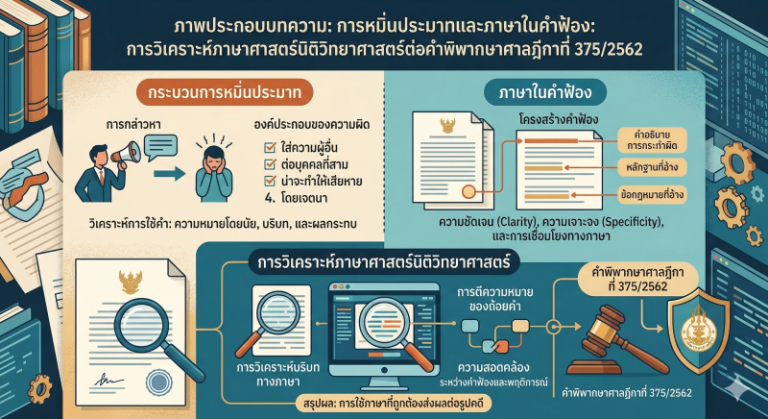
A key issue in this case did not merely concern whether the defendant had actually made the statements, but rather which specific statements had been formally included in the indictment. Under Section 158 paragraph two of the Thai Criminal Procedure Code, an indictment must clearly describe the factual elements constituting the alleged offence. In defamation cases, the specific words or expressions that allegedly constitute defamation are themselves an essential element of the crime. Consequently, those words must be explicitly included in the indictment. If particular statements are not specified in the indictment, the court cannot rely on them as a basis for convicting the defendant.
During the trial, witnesses for the plaintiff testified that the defendant had used several defamatory statements, including accusations that the plaintiff had stolen temple funds and that a photograph of the plaintiff had been displayed to the public. However, these additional elements were not explicitly described in the original indictment. The Supreme Court therefore held that such statements could not be considered as grounds for criminal liability. This reasoning follows Section 192 paragraph four of the Criminal Procedure Code, which provides that the court may only convict a defendant on the basis of facts that appear in the indictment.
From the perspective of Forensic Linguistics, this issue illustrates the concept of the textual boundary of the indictment. The indictment functions not merely as a narrative description of events but as a legally binding textual framework that defines the scope of judicial evaluation. Language within the indictment determines the permissible boundaries of evidence and legal reasoning. If allegedly defamatory statements fall outside this textual boundary, the court is procedurally barred from using them as a basis for conviction, even if evidence demonstrates that such statements were in fact made.
The case also highlights the importance of interpreting language within its social and communicative context. While the phrase “con artist” carries a clearly defamatory meaning in ordinary usage and may potentially damage a person’s reputation, the Supreme Court considered the broader context in which the statement was made. The defendant, as the person responsible for overseeing the monastic retreat, had legitimate concerns regarding the handling of donation funds. The warning issued to visitors was interpreted as an attempt to prevent further financial mismanagement and protect the interests of the religious institution.
This reasoning aligns with principles in pragmatics, a branch of linguistic analysis frequently applied in forensic linguistics. Pragmatics emphasizes that meaning is not derived solely from the literal words used, but also from the interaction between the speaker’s intention, the audience’s interpretation, and the situational context. A statement that appears defamatory when isolated from context may acquire a different legal meaning when the communicative purpose and surrounding circumstances are taken into account.
The Supreme Court ultimately determined that the defendant’s statements fell within the scope of good-faith communication intended to protect legitimate interests, as provided under Section 329(1) of the Thai Criminal Code. This provision establishes a defense to defamation when statements are made in good faith for the protection of oneself or one’s legitimate interests. Since the defendant’s conduct was deemed to fall within this exception, the court concluded that no criminal defamation had occurred.
Because the criminal claim failed, the accompanying civil claim for damages—which had been filed as a civil action connected to the criminal proceedings—could not succeed either. Without a criminally wrongful act, there was no unlawful act or tort capable of giving rise to civil liability. The Supreme Court therefore affirmed the appellate court’s decision to dismiss the plaintiff’s claim.
This judgment clearly demonstrates that language is not merely a vehicle for presenting facts in legal proceedings but a structural component of legal reasoning itself. The wording of an indictment, the precise statements attributed to the defendant, and the contextual interpretation of those statements all play decisive roles in determining criminal liability. In defamation law, linguistic precision is particularly crucial because a single word or phrase may determine whether a statement constitutes a criminal offence.
From a forensic linguistic perspective, this case underscores the importance of analyzing legal texts, communicative context, and pragmatic meaning in judicial decision-making. Such analysis helps clarify how courts interpret language in defamation cases and highlights the need for precise drafting of indictments and careful presentation of evidence. Ultimately, the case illustrates the profound interconnection between language and law, demonstrating that linguistic analysis can significantly contribute to a deeper understanding of judicial reasoning and legal outcomes.
This section provides information about certified translators, translation certifiers, and certified interpreters associated with SEAProTI.
The Southeast Asian Association of Professional Translators and Interpreters (SEAProTI) has officially shared the qualifications and requirements for becoming Certified Translators, Translation Certification Providers, and Certified Interpreters in Sections 9 and 10 of the Royal Gazette, which was published by the Prime Minister’s Office in Thailand on July 25, 2024. Certified Translators, Translation Certification Providers, and Certified Interpreters
The Council of State has proposed the enactment of a Royal Decree, granting registered translators and recognised translation certifiers from professional associations or accredited language institutions the authority to provide legally valid translation certification (Letter to SEAProTI dated April 28, 2025)
SEAProTI is the first professional association in Thailand and Southeast Asia to implement a comprehensive certification system for translators, certifiers, and interpreters.
Head Office: Baan Ratchakru Building, No. 33, Room 402, Soi Phahonyothin 5, Phahonyothin Road, Phaya Thai District, Bangkok 10400, Thailand
Email: hello@seaproti.com | Tel.: (+66) 2-114-3128 (Office hours: Mon–Fri, 09:00–17:00)
การวิเคราะห์คำพิพากษาศาลฎีกาที่ 375/2562 ในมุมมองนิติภาษาศาสตร์ (Forensic Linguistics):
ความสำคัญของถ้อยคำในคำฟ้องและบริบทของการสื่อสารในคดีหมิ่นประมาท
ผู้แต่ง วณิชชา สุมานัส นายกสมาคมวิชาชีพนักแปลและล่ามแห่งเอเชียตะวันออกเฉียงใต้ (SEAProTI) และนักนิติภาษาศาสตร์วิชาชีพ
6 มีนาคม 2569, กรุงเทพมหานคร – คดีหมิ่นประมาทเป็นคดีที่มีลักษณะเฉพาะ เนื่องจาก “ภาษา” เป็นองค์ประกอบสำคัญของความผิดโดยตรง ต่างจากคดีอาญาประเภทอื่นที่พฤติการณ์ทางกายภาพเป็นหลักฐานสำคัญ ในคดีหมิ่นประมาท การพิสูจน์ความผิดต้องอาศัยการวิเคราะห์ถ้อยคำที่ถูกกล่าว การสื่อสารที่เกิดขึ้น และบริบทของการใช้ภาษา คำพิพากษาศาลฎีกาที่ 375/2562 จึงเป็นกรณีศึกษาที่สำคัญในการทำความเข้าใจความสัมพันธ์ระหว่างภาษา กฎหมาย และกระบวนการพิจารณาคดี โดยเฉพาะเมื่อพิจารณาผ่านกรอบแนวคิดของนิติภาษาศาสตร์ (Forensic Linguistics)
คดีดังกล่าวมีข้อเท็จจริงว่า จำเลยซึ่งเป็นพระภิกษุและเป็นผู้ดูแลสำนักสงฆ์ ได้กล่าวถ้อยคำผ่านเครื่องขยายเสียงว่าผู้เสียหายเป็น “มนุษย์สิบแปดมงกุฎ” และมีการกล่าวถึงการยักยอกเงินบริจาคจำนวนหลายล้านบาท โดยเหตุการณ์เกิดขึ้นภายหลังจากที่จำเลยได้มอบหมายให้ผู้เสียหายเป็นผู้ดูแลเงินบริจาคของสำนักสงฆ์ในช่วงที่จำเลยไม่อยู่ในพื้นที่ ต่อมาเมื่อเกิดข้อสงสัยเกี่ยวกับเงินบริจาค จำเลยจึงประกาศเตือนประชาชนไม่ให้มอบเงินผ่านผู้เสียหาย ผู้เสียหายจึงยื่นฟ้องคดีหมิ่นประมาท โดยกล่าวอ้างว่าถ้อยคำดังกล่าวทำให้เสื่อมเสียชื่อเสียง
ประเด็นสำคัญในคดีนี้ไม่ได้อยู่ที่เพียงว่าจำเลยกล่าวถ้อยคำดังกล่าวจริงหรือไม่ แต่กลับอยู่ที่ “ถ้อยคำใดบ้างที่ถูกระบุไว้ในคำฟ้อง” ตามหลักกฎหมายวิธีพิจารณาความอาญา มาตรา 158 วรรคสอง การบรรยายฟ้องต้องระบุข้อเท็จจริงที่เป็นองค์ประกอบของความผิดอย่างชัดเจน ในคดีหมิ่นประมาท ถ้อยคำที่ใช้กล่าวหมิ่นประมาทถือเป็นองค์ประกอบสำคัญของความผิด ดังนั้น ถ้อยคำดังกล่าวจึงต้องถูกบรรยายไว้ในคำฟ้องโดยชัดแจ้ง หากไม่มีการระบุไว้ ศาลไม่สามารถนำข้อเท็จจริงนั้นมาพิจารณาลงโทษจำเลยได้
ในคดีนี้ แม้พยานโจทก์จะเบิกความว่า จำเลยได้กล่าวถ้อยคำหลายลักษณะ เช่น กล่าวหาว่าโจทก์โกงเงินวัด และมีการติดภาพถ่ายของโจทก์ไว้เพื่อให้ประชาชนรับรู้ แต่ข้อเท็จจริงดังกล่าวไม่ได้ถูกบรรยายไว้ในคำฟ้องโดยตรง ศาลฎีกาจึงวินิจฉัยว่า ข้อความเหล่านี้ไม่อาจนำมาพิจารณาเป็นเหตุแห่งความผิดได้ ตามประมวลกฎหมายวิธีพิจารณาความอาญา มาตรา 192 วรรคสี่ ซึ่งกำหนดว่าศาลจะลงโทษจำเลยได้เฉพาะข้อเท็จจริงที่ปรากฏอยู่ในคำฟ้องเท่านั้น
ในมุมมองของนิติภาษาศาสตร์ ประเด็นนี้สะท้อนแนวคิดที่สำคัญเกี่ยวกับ “ขอบเขตทางข้อความของคำฟ้อง” หรือ textual boundary of the indictment กล่าวคือ คำฟ้องทำหน้าที่เป็นกรอบข้อความที่กำหนดขอบเขตของข้อเท็จจริงที่ศาลสามารถพิจารณาได้ ภาษาที่ใช้ในคำฟ้องจึงไม่ได้เป็นเพียงการบรรยายเหตุการณ์ แต่เป็นโครงสร้างทางกฎหมายที่กำหนดขอบเขตของการพิสูจน์ความผิด หากถ้อยคำที่เกี่ยวข้องกับการหมิ่นประมาทไม่ได้ถูกรวมไว้ในโครงสร้างข้อความดังกล่าว ศาลย่อมไม่สามารถนำมาประกอบการพิจารณาได้ แม้ว่าจะมีพยานหลักฐานรองรับก็ตาม
นอกจากนี้ คดีดังกล่าวยังสะท้อนบทบาทของการตีความภาษาในบริบททางสังคมและสถานการณ์เฉพาะของการสื่อสาร แม้ถ้อยคำว่า “มนุษย์สิบแปดมงกุฎ” จะมีความหมายในเชิงดูหมิ่นและอาจก่อให้เกิดความเสียหายต่อชื่อเสียงของบุคคลได้ แต่ศาลฎีกาได้พิจารณาบริบทของการใช้ถ้อยคำดังกล่าวร่วมด้วย โดยเห็นว่า จำเลยกล่าวถ้อยคำดังกล่าวในฐานะผู้ดูแลสำนักสงฆ์ และมีเหตุผลที่จะสงสัยเกี่ยวกับการจัดการเงินบริจาคของผู้เสียหาย การกล่าวเตือนประชาชนจึงเป็นการกระทำเพื่อป้องกันผลประโยชน์ของตนและของสำนักสงฆ์
หลักการดังกล่าวสอดคล้องกับแนวคิดด้านวัจนปฏิบัติศาสตร์ (pragmatics) ในศาสตร์นิติภาษาศาสตร์ ซึ่งเน้นว่าความหมายของถ้อยคำไม่ได้เกิดจากตัวคำเพียงอย่างเดียว แต่เกิดจากการปฏิสัมพันธ์ระหว่างถ้อยคำ ผู้พูด ผู้ฟัง และบริบทของสถานการณ์ การประเมินว่าถ้อยคำใดเป็นการหมิ่นประมาทจึงต้องพิจารณาเจตนาของผู้พูดและวัตถุประสงค์ของการสื่อสารร่วมด้วย
ศาลฎีกาจึงวินิจฉัยว่า การกระทำของจำเลยเข้าลักษณะการกระทำโดยสุจริตเพื่อป้องกันตนหรือส่วนได้เสียเกี่ยวกับตนตามคลองธรรม ตามประมวลกฎหมายอาญา มาตรา 329 (1) ซึ่งเป็นข้อยกเว้นความผิดฐานหมิ่นประมาท เมื่อการกระทำของจำเลยไม่เป็นความผิดทางอาญา การเรียกร้องค่าสินไหมทดแทนในส่วนแพ่งซึ่งเกี่ยวเนื่องกับคดีอาญาจึงไม่อาจรับฟังได้เช่นกัน เนื่องจากไม่ปรากฏการกระทำอันเป็นละเมิดตามกฎหมาย
คำพิพากษาศาลฎีกาคดีนี้จึงสะท้อนให้เห็นอย่างชัดเจนว่า ภาษาไม่ได้เป็นเพียงเครื่องมือในการสื่อสารข้อเท็จจริงในกระบวนการยุติธรรมเท่านั้น แต่ยังเป็นโครงสร้างพื้นฐานที่กำหนดขอบเขตของการพิจารณาคดี การเลือกใช้ถ้อยคำในคำฟ้อง การระบุข้อความที่เป็นข้อกล่าวหา และการตีความบริบทของการสื่อสาร ล้วนมีผลโดยตรงต่อผลของคดี ในคดีหมิ่นประมาท ความแม่นยำของถ้อยคำจึงมีความสำคัญอย่างยิ่ง เพราะถ้อยคำเพียงคำเดียวอาจเป็นตัวกำหนดว่าการกระทำนั้นจะถือเป็นความผิดทางอาญาหรือไม่
ในมิติของนิติภาษาศาสตร์ คดีนี้จึงเป็นตัวอย่างที่แสดงให้เห็นถึงความสำคัญของการวิเคราะห์ภาษาในกระบวนการยุติธรรม ทั้งในด้านโครงสร้างข้อความของเอกสารทางกฎหมาย การตีความความหมายของถ้อยคำ และการประเมินบริบทของการสื่อสาร การทำความเข้าใจความสัมพันธ์ระหว่างภาษาและกฎหมายในลักษณะดังกล่าวไม่เพียงช่วยอธิบายเหตุผลของคำพิพากษาเท่านั้น แต่ยังช่วยยกระดับมาตรฐานของการเขียนคำฟ้อง การนำสืบพยานหลักฐาน และการตีความถ้อยคำในคดีหมิ่นประมาทในอนาคตอีกด้วย
สมาคมวิชาชีพนักแปลและล่ามแห่งเอเชียตะวันออกเฉียงใต้ (SEAProTI) ได้ประกาศหลักเกณฑ์และคุณสมบัติของผู้ที่ขึ้นทะเบียนเป็น “นักแปลรับรอง (Certified Translators) และผู้รับรองการแปล (Translation Certification Providers) และล่ามรับรอง (Certified Interpreters)” ของสมาคม หมวดที่ 9 และหมวดที่ 10 ในราชกิจจานุเบกษา ของสำนักเลขาธิการคณะรัฐมนตรี ในสำนักนายกรัฐมนตรี แห่งราชอาณาจักรไทย ลงวันที่ 25 ก.ค. 2567 เล่มที่ 141 ตอนที่ 66 ง หน้า 100 อ่านฉบับเต็มได้ที่: นักแปลรับรอง ผู้รับรองการแปล และล่ามรับรอง
สำนักคณะกรรมการกฤษฎีกาเสนอให้ตราเป็นพระราชกฤษฎีกา โดยกำหนดให้นักแปลที่ขึ้นทะเบียน รวมถึงผู้รับรองการแปลจากสมาคมวิชาชีพหรือสถาบันสอนภาษาที่มีการอบรมและขึ้นทะเบียน สามารถรับรองคำแปลได้ (จดหมายถึงสมาคม SEAProTI ลงวันที่ 28 เม.ย. 2568)
สมาคมวิชาชีพนักแปลและล่ามแห่งเอเชียตะวันออกเฉียงใต้เป็นสมาคมวิชาชีพแห่งแรกและแห่งเดียวในประเทศไทยและภูมิภาคเอเชียตะวันออกเฉียงใต้ที่มีระบบรับรองนักแปลรับรอง ผู้รับรองการแปล และล่ามรับรอง
สำนักงานใหญ่: อาคารบ้านราชครู เลขที่ 33 ห้อง 402 ซอยพหลโยธิน 5 ถนนพหลโยธิน แขวงพญาไท เขตพญาไท กรุงเทพมหานคร 10400 ประเทศไทย
อีเมล: hello@seaproti.com โทรศัพท์: (+66) 2-114-3128 (เวลาทำการ: วันจันทร์–วันศุกร์ เวลา 09.00–17.00 น.