



Forensic Linguistics and Procedural Constraints:
An Analysis of Thai Supreme Court Judgment No. 375/2562
Author: Wanitcha Sumanat, President of the Southeast Asian Association of Professional Translators and Interpreters (SEAProT), and certified forensic linguist
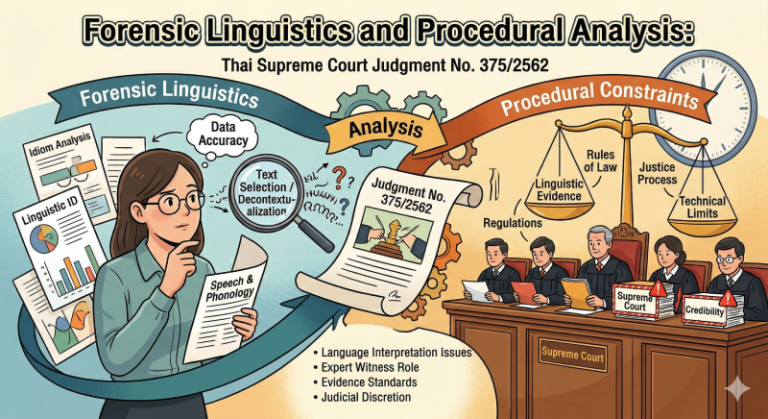
Supreme Court Judgment No. 375/2562 offers a compelling case study illustrating the intricate relationship between language and criminal procedure, particularly in defamation cases where utterances are not merely evidentiary elements but constitute the core components of the offence itself. From a forensic linguistic perspective, the case reveals how language functions as a structural mechanism that shapes the boundaries of judicial reasoning and legal accountability.
At the heart of the case lies the interpretation and application of Section 158, paragraph two of the Thai Criminal Procedure Code, which requires the plaintiff to explicitly state the defamatory words in the complaint. The Supreme Court held that any statements or acts not specified in the complaint fall outside the scope of judicial consideration, even if supported by credible evidence. This principle underscores the procedural limitation that only linguistically codified allegations, those formally articulated in the complaint, can be adjudicated.
From a forensic linguistic standpoint, this reflects the principle of linguistic delimitation. The complaint operates as a linguistic frame that defines the permissible scope of interpretation. Extralinguistic reality, events, or statements that occurred in fact hold no legal relevance unless they are transformed into formal legal language and properly embedded within the complaint. In this sense, language does not merely describe reality; it constructs legally cognizable reality.
The factual matrix of the case demonstrates that although witnesses testified to additional defamatory content, including allegations of embezzlement and the public display of the plaintiff’s photograph, these elements were excluded from judicial consideration because they were not included in the complaint. Pursuant to Section 192, paragraph four, the Court could not rely on such facts in determining criminal liability. This reflects the distinction between factual truth and procedural truth: the latter being the only form of truth recognized within the judicial process.
The case also provides an important illustration of speech act analysis. The Court ultimately limited its consideration to the phrase “a fraudulent person” (sip-ed mongkut), which corresponded to the wording in the complaint. While this expression carries defamatory implications, the Court evaluated it within its broader communicative context. It found that the defendant, who was responsible for managing the monastic establishment, had reasonable grounds to question the handling of donation funds and made the statement to protect legitimate interests.
Accordingly, the Court applied Section 329(1) of the Penal Code, which exempts from liability statements made in good faith to protect legitimate interests. This reasoning aligns with the concept of pragmatic meaning in forensic linguistics, where interpretation extends beyond literal wording to include intent and social context. The meaning of an utterance is thus co-constructed by linguistic form, speaker intention, and situational factors.
Another notable aspect of the judgment is the Court’s exercise of its authority under Sections 195, paragraph two, and 225 of the Criminal Procedure Code to raise a legal issue concerning public order ex officio, even though it had not been argued by the parties. This reflects the Court’s role not merely as an arbiter of disputes but as a guardian of legal correctness and procedural integrity.
In the civil dimension, the Court reaffirmed the principle that civil liability arising from a criminal case must be determined in accordance with the findings in the criminal judgment. Since the defendant’s actions were deemed lawful and carried out in good faith, they did not constitute a tort, and therefore no damages were payable.
In conclusion, this judgment carries significant implications for forensic linguistics. It demonstrates that language in legal proceedings is not a neutral medium but a truth-defining mechanism that determines the scope of legal responsibility. The omission of critical linguistic elements in a complaint effectively precludes their consideration in legal proceedings.
For professional translators and interpreters, particularly in legal contexts, the case underscores the importance of structural accuracy as well as semantic precision. The legal consequences of linguistic choices are profound: even minor omissions or discrepancies can lead to the exclusion of key facts from judicial consideration. Forensic linguistics, therefore, is not only a tool for analyzing language in legal cases but also an essential framework for ensuring justice through the disciplined and precise use of language.
For professional services, please visit: https://www.seaproti.org/practitioners/
About certified translators, translation certifiers, and certified interpreters associated with SEAProTI.
The Southeast Asian Association of Professional Translators and Interpreters (SEAProTI) has officially shared the qualifications and requirements for becoming Certified Translators, Translation Certification Providers, and Certified Interpreters in Sections 9 and 10 of the Royal Gazette, which was published by the Prime Minister’s Office in Thailand on July 25, 2024. Certified Translators, Translation Certification Providers, and Certified Interpreters
The Council of State has proposed the enactment of a Royal Decree, granting registered translators and recognised translation certifiers from professional associations or accredited language institutions the authority to provide legally valid translation certification (Letter to SEAProTI dated April 28, 2025)
SEAProTI is the first professional association in Thailand and Southeast Asia to implement a comprehensive certification system for translators, certifiers, and interpreters.
Head Office: Baan Ratchakru Building, No. 33, Room 402, Soi Phahonyothin 5, Phahonyothin Road, Phaya Thai District, Bangkok 10400, Thailand
Email: hello@seaproti.com | Tel.: (+66) 2-114-3128 (Office hours: Mon–Fri, 09:00–17:00).
นิติภาษาศาสตร์กับข้อจำกัดเชิงกระบวนพิจารณา: การวิเคราะห์คำพิพากษาศาลฎีกาที่ 375/2562
ผู้แต่ง วณิชชา สุมานัส นายกสมาคมวิชาชีพนักแปลและล่ามแห่งเอเชียตะวันออกเฉียงใต้ และนักนิติภาษาศาสตร์วิชาชีพ
คำพิพากษาศาลฎีกาที่ 375/2562 เป็นกรณีศึกษาที่สะท้อนให้เห็นถึงความสัมพันธ์ระหว่าง “ภาษา” กับ “กฎหมายวิธีพิจารณาความอาญา” อย่างชัดเจน โดยเฉพาะในคดีหมิ่นประมาท ซึ่งถ้อยคำ (utterances) มิได้เป็นเพียงพยานหลักฐาน หากแต่เป็น “องค์ประกอบความผิด” ที่ต้องถูกกำหนดและจำกัดขอบเขตไว้ตั้งแต่ชั้นฟ้องคดี การวิเคราะห์ในเชิงนิติภาษาศาสตร์จึงสามารถเปิดเผยโครงสร้างเชิงอำนาจของภาษาในกระบวนการยุติธรรมได้อย่างลึกซึ้ง
ประเด็นสำคัญในคดีนี้อยู่ที่การตีความและการบังคับใช้ประมวลกฎหมายวิธีพิจารณาความอาญา มาตรา 158 วรรคสอง ซึ่งกำหนดให้โจทก์ต้องบรรยาย “ถ้อยคำที่เป็นข้อหมิ่นประมาท” ไว้อย่างชัดเจนในคำฟ้อง ศาลฎีกาวินิจฉัยว่า ถ้อยคำหรือพฤติการณ์ใดที่มิได้ถูกบรรยายไว้ ย่อมไม่อยู่ในขอบเขตที่ศาลสามารถนำมาพิจารณาลงโทษได้ แม้ข้อเท็จจริงในทางพยานหลักฐานจะรับฟังได้ว่ามีการกล่าวหรือกระทำเช่นนั้นจริงก็ตาม
ในเชิงนิติภาษาศาสตร์ ประเด็นนี้สะท้อนหลักการที่สำคัญคือ “linguistic delimitation” หรือการกำหนดขอบเขตของความหมายผ่านถ้อยคำในเอกสารทางกฎหมาย กล่าวคือ คำฟ้องทำหน้าที่เป็น “กรอบภาษา” (linguistic frame) ที่จำกัดสิ่งที่ศาลสามารถรับรู้และวินิจฉัยได้ ความจริงในโลกภายนอก (extralinguistic reality) จะไม่มีสถานะทางกฎหมาย หากไม่ได้ถูก “แปลงเป็นภาษา” และบรรจุไว้ในคำฟ้องอย่างถูกต้องครบถ้วน
ข้อเท็จจริงในคดีแสดงให้เห็นว่า แม้พยานจะเบิกความถึงถ้อยคำเพิ่มเติม เช่น การกล่าวหาว่าโจทก์ยักยอกเงิน หรือการติดภาพถ่ายประกอบการกล่าวหา แต่เมื่อถ้อยคำและพฤติการณ์เหล่านั้นมิได้ถูกระบุในคำฟ้อง ศาลฎีกาจึงไม่สามารถนำมาพิจารณาได้ตามมาตรา 192 วรรคสี่ หลักการนี้สะท้อนแนวคิดเรื่อง “procedural truth” ซึ่งแตกต่างจาก “factual truth” กล่าวคือ ความจริงที่ศาลยอมรับต้องเป็นความจริงที่ผ่านกระบวนการทางภาษาและขั้นตอนทางกฎหมายแล้วเท่านั้น
นอกจากนี้ คดีนี้ยังเปิดมิติสำคัญของ “speech act analysis” ในทางนิติภาษาศาสตร์ โดยศาลจำกัดการพิจารณาเฉพาะถ้อยคำที่ตรงกับคำฟ้อง คือ “เป็นมนุษย์สิบแปดมงกุฎ” ซึ่งถือเป็นการแสดงออกเชิงภาษาที่มีลักษณะเป็นการใส่ความ อย่างไรก็ตาม ศาลได้พิจารณาบริบท (context) ของการสื่อสารร่วมด้วย โดยเห็นว่าจำเลยในฐานะผู้ดูแลสำนักสงฆ์ มีเหตุอันควรสงสัยเกี่ยวกับการจัดการเงินบริจาค และการกล่าวถ้อยคำดังกล่าวมีวัตถุประสงค์เพื่อป้องกันความเสียหายต่อส่วนได้เสียของตน
ในแง่นี้ ศาลได้นำหลักตามประมวลกฎหมายอาญา มาตรา 329 (1) มาใช้ ซึ่งยกเว้นความผิดฐานหมิ่นประมาท หากเป็นการแสดงความคิดเห็นหรือข้อความโดยสุจริต เพื่อป้องกันตนหรือส่วนได้เสียโดยชอบธรรม การวินิจฉัยดังกล่าวสะท้อนแนวคิด “pragmatic meaning” ในทางนิติภาษาศาสตร์ กล่าวคือ ความหมายของถ้อยคำมิได้ถูกตีความเฉพาะตัวบท (literal meaning) แต่ต้องพิจารณาร่วมกับเจตนา (intent) และบริบททางสังคม (social context)
อีกประเด็นที่น่าสนใจคือ ศาลฎีกาได้ยกปัญหาข้อกฎหมายเกี่ยวกับความสงบเรียบร้อยขึ้นวินิจฉัยเอง แม้คู่ความจะมิได้ยกขึ้นฎีกา ซึ่งเป็นไปตามมาตรา 195 วรรคสอง ประกอบมาตรา 225 แสดงให้เห็นถึงบทบาทของศาลในฐานะ “ผู้ควบคุมความถูกต้องของกระบวนการทางกฎหมาย” (guardian of legal order) มากกว่าการเป็นเพียงผู้ชี้ขาดข้อพิพาทตามที่คู่ความเสนอ
ในส่วนของความรับผิดทางแพ่ง ศาลวินิจฉัยตามหลักที่ว่า คดีแพ่งที่เกี่ยวเนื่องกับคดีอาญาต้องยึดข้อเท็จจริงตามคำพิพากษาคดีอาญา เมื่อการกระทำของจำเลยไม่เป็นความผิดและเป็นการกระทำโดยสุจริต จึงไม่เป็นละเมิดและไม่ก่อให้เกิดความรับผิดในการชดใช้ค่าสินไหมทดแทน
โดยสรุป คำพิพากษานี้มีนัยสำคัญในเชิงนิติภาษาศาสตร์อย่างยิ่ง กล่าวคือ ภาษาไม่ได้เป็นเพียงเครื่องมือในการสื่อสารในกระบวนการยุติธรรม แต่เป็น “กลไกกำหนดความจริง” (truth-defining mechanism) ที่มีผลโดยตรงต่อขอบเขตของความรับผิดทางอาญาและแพ่ง การไม่บรรยายถ้อยคำหรือพฤติการณ์ที่เป็นองค์ประกอบความผิดไว้ในคำฟ้อง เท่ากับเป็นการ “ลบ” ความจริงนั้นออกจากระบบกฎหมายโดยปริยาย
ในบริบทของวิชาชีพนักแปลและล่าม โดยเฉพาะในคดีอาญา คำพิพากษานี้ชี้ให้เห็นถึงความสำคัญของ “ความแม่นยำเชิงโครงสร้าง” (structural accuracy) มากกว่าความถูกต้องเชิงความหมายเพียงอย่างเดียว กล่าวคือ การถ่ายทอดถ้อยคำต้องคำนึงถึงผลทางกฎหมายของถ้อยคำแต่ละคำ เนื่องจากความคลาดเคลื่อนเพียงเล็กน้อยอาจส่งผลให้ข้อเท็จจริงสำคัญ “ตกหล่น” จากคำฟ้อง และไม่สามารถนำมาใช้ในกระบวนการพิจารณาได้ในที่สุด
ดังนั้น นิติภาษาศาสตร์จึงมิใช่เพียงศาสตร์ที่ช่วยวิเคราะห์ภาษาในคดีความ แต่ยังเป็นเครื่องมือสำคัญในการออกแบบ การควบคุม และการประกันความยุติธรรมผ่านภาษาในระบบกฎหมายอีกด้วย
ติดต่อขอใช้บริการนักวิชาชีพของสมาคมได้ที่: https://www.seaproti.org/practitioners/
สมาคมวิชาชีพนักแปลและล่ามแห่งเอเชียตะวันออกเฉียงใต้ (SEAProTI) ได้ประกาศหลักเกณฑ์และคุณสมบัติของผู้ที่ขึ้นทะเบียนเป็น “นักแปลรับรอง (Certified Translators) และผู้รับรองการแปล (Translation Certification Providers) และล่ามรับรอง (Certified Interpreters)” ของสมาคม หมวดที่ 9 และหมวดที่ 10 ในราชกิจจานุเบกษา ของสำนักเลขาธิการคณะรัฐมนตรี ในสำนักนายกรัฐมนตรี แห่งราชอาณาจักรไทย ลงวันที่ 25 ก.ค. 2567 เล่มที่ 141 ตอนที่ 66 ง หน้า 100 อ่านฉบับเต็มได้ที่: นักแปลรับรอง ผู้รับรองการแปล และล่ามรับรอง
สำนักคณะกรรมการกฤษฎีกาเสนอให้ตราเป็นพระราชกฤษฎีกา โดยกำหนดให้นักแปลที่ขึ้นทะเบียน รวมถึงผู้รับรองการแปลจากสมาคมวิชาชีพหรือสถาบันสอนภาษาที่มีการอบรมและขึ้นทะเบียน สามารถรับรองคำแปลได้ (จดหมายถึงสมาคม SEAProTI ลงวันที่ 28 เม.ย. 2568)
สมาคมวิชาชีพนักแปลและล่ามแห่งเอเชียตะวันออกเฉียงใต้เป็นสมาคมวิชาชีพแห่งแรกและแห่งเดียวในประเทศไทยและภูมิภาคเอเชียตะวันออกเฉียงใต้ที่มีระบบรับรองนักแปลรับรอง ผู้รับรองการแปล และล่ามรับรอง
สำนักงานใหญ่: อาคารบ้านราชครู เลขที่ 33 ห้อง 402 ซอยพหลโยธิน 5 ถนนพหลโยธิน แขวงพญาไท เขตพญาไท กรุงเทพมหานคร 10400 ประเทศไทย
อีเมล: hello@seaproti.com โทรศัพท์: (+66) 2-114-3128 (เวลาทำการ: วันจันทร์–วันศุกร์ เวลา 09.00–17.00 น.