


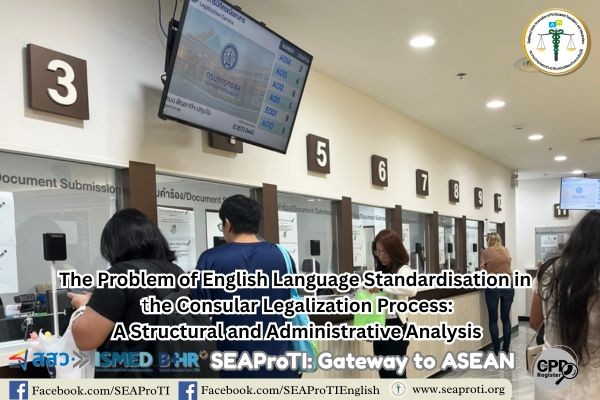
The Problem of English Language Standardisation in the Consular Legalisation Process:
A Structural and Administrative Analysis
12 December 2025, Bangkok – The use of English in Thai official documents, particularly within the document legalisation process administered by the Department of Consular Affairs of the Ministry of Foreign Affairs, has long generated confusion and controversy in practice among translators, service users, and related stakeholders. A recurring phenomenon is that translated documents employing internationally accepted English terminology, or even terminology taken directly from official forms published by the Department itself, are nevertheless required to be amended by officials at the Legalisation and Nationality Division. Such amendments are often based on the individual discretion of the examining officer, despite the fact that the original wording is neither linguistically incorrect nor substantively misleading. This situation does not stem from individual linguistic incompetence, but rather reflects a deeper structural limitation in the way language is managed within the Thai administrative system.
First, the English used in documents issued or endorsed by the Department of Consular Affairs is not anchored to any clearly defined standard of legal or official English. It is not explicitly aligned with British Legal English, American Legal English, or internationally recognised terminology frameworks such as those used in the Hague Convention or by civil registration authorities in English-speaking jurisdictions. Instead, the English found in many consular forms and templates has evolved organically within the Thai bureaucratic context. It is the product of cumulative translations produced over time by different officials and contractors, shaped more by internal administrative practice and institutional memory than by systematic reference to international linguistic standards. This phenomenon is consistent with what translation scholars have described as “institutionalised non-native legal English,” where administrative convenience and precedent take precedence over linguistic standardisation (Cao, 2007; Šarčević, 1997).
Second, the Department lacks a centralised system for terminology control or language governance. There is no officially promulgated bilingual glossary, no binding English style guide, and no translation policy that constrains or guides officials in their assessment of translated documents. As a result, decisions regarding English wording are heavily influenced by personal familiarity, habit, or prior experience of individual officers. In such an environment, alternative but equally valid English expressions can readily be deemed “incorrect” or “inappropriate,” not on the basis of linguistic error, but because they diverge from the examiner’s preferred usage. This absence of a shared reference framework reflects a broader administrative weakness commonly identified in public-sector multilingual governance, where discretion substitutes for codified standards (Hood, 2011; Pym, 2014).
Third, the legalisation of documents is, by its nature, an administrative procedure rather than a linguistic quality assurance process. Its primary purpose is not to certify the accuracy or stylistic adequacy of a translation, but to authenticate a document for further use within governmental or cross-border administrative systems. Consequently, the review conducted by legalisation officers is grounded in administrative discretion rather than in principles of linguistics or translation studies. From the perspective of administrative law, such discretion is legally permissible, yet it becomes problematic when exercised in the absence of transparent criteria or reviewable standards (Galligan, 2016). Since the legalisation process is not designed to validate translations as such, officers are under no formal obligation to justify requested amendments by reference to recognised language standards, and terminology may therefore be altered according to subjective judgment.
Moreover, although the Department publishes English-language forms and templates on its official website, these documents do not, in legal or practical terms, bind the discretion of officers during the legalisation process. Compliance with the wording provided in such forms therefore offers no guarantee that a document will be accepted without revision. This disconnect between officially issued language and the criteria applied in actual examination highlights a systemic lack of integration between document production and administrative enforcement. Similar inconsistencies have been observed in other jurisdictions where multilingual administrative documentation lacks a formally designated “authoritative language version” (Mattila, 2013).
The practical consequences of this situation are borne primarily by translators and service users. Requests for amendments are frequently interpreted as evidence of translation error or professional inadequacy, when in fact they often reflect nothing more than differences in register, collocation, or jurisdictional preference within standard English usage. From a professional ethics perspective, this misattribution of responsibility undermines the role of translators as accountable language professionals and repositions them as mere intermediaries required to conform to fluctuating administrative preferences (Chesterman, 2017). The state’s failure to establish a clear linguistic standard thus creates unnecessary repetition, delays, and costs, while simultaneously diminishing confidence in the legalisation system.
In conclusion, the lack of standardisation in the use of English within the consular legalisation process is not fundamentally a linguistic problem, but a structural one rooted in administrative practice. Addressing this issue requires recognition that English, when used in governmental procedures, carries legal and practical consequences for individuals and institutions alike. Sustainable reform must therefore involve the development of transparent, systematic, and internationally aligned language standards, supported by officially endorsed glossaries and binding style guides. Without such measures, reliance on the discretionary experience of individual officers will continue to produce inconsistency, inefficiency, and uncertainty in the legalization of translated documents.
References
- Cao, D. (2007). Translating law. Multilingual Matters.
- Chesterman, A. (2017). Reflections on translation theory: Selected papers 1993–2014. John Benjamins.
- Galligan, D. J. (2016). Discretionary powers: A legal study of official discretion. Oxford University Press.
- Hood, C. (2011). The blame game: Spin, bureaucracy, and self-preservation in government. Princeton University Press.
- Mattila, H. E. S. (2013). Comparative legal linguistics: Language of law, Latin and modern lingua franca (2nd ed.). Ashgate.
- Pym, A. (2014). Exploring translation theories (2nd ed.). Routledge.
- Šarčević, S. (1997). New approach to legal translation. Kluwer Law International.
About Certified Translators, Translation Certifiers, and Certified Interpreters of SEAProTI
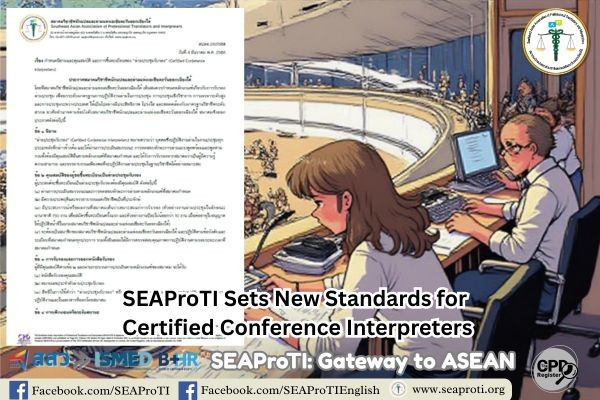
The Southeast Asian Association of Professional Translators and Interpreters (SEAProTI) has formally announced the qualifications and requirements for registration of Certified Translators, Translation Certification Providers, and Certified Interpreters in Sections 9 and 10 of the Royal Gazette, published by the Secretariat of the Cabinet, Office of the Prime Minister of Thailand, on 25 July 2024 (Vol. 141, Part 66 Ng, p. 100). Certified Translators, Translation Certification Providers, and Certified Interpreters
The Council of State has proposed the enactment of a Royal Decree, granting registered translators and recognized translation certifiers from professional associations or accredited language institutions the authority to provide legally valid translation certification (Letter to SEAProTI dated April 28, 2025)
SEAProTI is the first professional association in Thailand and Southeast Asia to implement a comprehensive certification system for translators, certifiers, and interpreters.
Head Office: Baan Ratchakru Building, No. 33, Room 402, Soi Phahonyothin 5, Phahonyothin Road, Phaya Thai District, Bangkok 10400, Thailand
Email: hello@seaproti.com | Tel.: (+66) 2-114-3128 (Office hours: Mon–Fri, 09:00–17:00)
ปัญหามาตรฐานการใช้ภาษาอังกฤษในกระบวนการนิติกรณ์เอกสารของกรมการกงสุล:
การวิเคราะห์เชิงโครงสร้างและเชิงปกครอง
12 ธันวาคม 2568, กรุงเทพมหานคร – การใช้ภาษาอังกฤษในเอกสารราชการไทย โดยเฉพาะในกระบวนการนิติกรณ์เอกสารของกรมการกงสุล กระทรวงการต่างประเทศ เป็นประเด็นที่ก่อให้เกิดความสับสนและข้อโต้แย้งอย่างต่อเนื่องในทางปฏิบัติ ทั้งในหมู่นักแปล ผู้ใช้บริการ และหน่วยงานที่เกี่ยวข้อง ปรากฏการณ์ที่พบได้บ่อยคือ เอกสารแปลซึ่งใช้ถ้อยคำภาษาอังกฤษที่ถูกต้องตามหลักสากลหรือเป็นไปตามแบบฟอร์มที่กรมการกงสุลเผยแพร่เอง กลับถูกเจ้าหน้าที่กองนิติกรณ์และสัญชาติขอให้แก้ไขถ้อยคำภาษาอังกฤษ โดยอาศัยดุลพินิจของเจ้าหน้าที่แต่ละราย ทั้งที่ความหมายของถ้อยคำเดิมมิได้คลาดเคลื่อนหรือผิดพลาดในเชิงภาษา ปัญหาดังกล่าวมิใช่เรื่องของความสามารถทางภาษาเฉพาะบุคคล หากแต่สะท้อนถึงข้อจำกัดเชิงโครงสร้างของระบบการใช้ภาษาในกระบวนการปกครองของรัฐไทย
ประการแรก ภาษาอังกฤษที่ใช้ในเอกสารของกรมการกงสุลมิได้ตั้งอยู่บนฐานของภาษาอังกฤษมาตรฐานทางกฎหมายหรือทางการใดโดยชัดแจ้ง ไม่ว่าจะเป็น British Legal English, American Legal English หรือศัพท์ที่ได้รับการยอมรับในกรอบอนุสัญญาระหว่างประเทศ เช่น Hague Convention หรือมาตรฐานของหน่วยงานทะเบียนพลเรือนในประเทศเจ้าของภาษา ภาษาอังกฤษที่ปรากฏในแบบฟอร์มและเอกสารราชการจำนวนมากจึงเป็นภาษาอังกฤษที่พัฒนาขึ้นจากการใช้งานภายในระบบราชการไทยเอง เป็นผลรวมของการแปลสะสมจากช่วงเวลาต่าง ๆ และจากประสบการณ์ของเจ้าหน้าที่แต่ละรุ่น มากกว่าจะเป็นภาษาที่ผ่านกระบวนการกำหนดมาตรฐานอย่างเป็นระบบ
ประการที่สอง กรมการกงสุลมิได้มีระบบควบคุมศัพท์หรือแนวปฏิบัติด้านภาษาที่เป็นเอกภาพ หน่วยงานไม่มีบัญชีศัพท์ภาษาอังกฤษอย่างเป็นทางการ ไม่มีคู่มือการใช้ภาษา หรือแนวทางการแปลที่ผูกพันเจ้าหน้าที่ในการพิจารณาเอกสาร ส่งผลให้การตัดสินใจเกี่ยวกับถ้อยคำภาษาอังกฤษขึ้นอยู่กับความคุ้นเคย ความเคยชิน หรือประสบการณ์ส่วนบุคคลของเจ้าหน้าที่ผู้ตรวจเอกสารเป็นสำคัญ ในสภาพเช่นนี้ ถ้อยคำภาษาอังกฤษที่มีความหมายใกล้เคียงหรือใช้แทนกันได้ในเชิงภาษา จึงสามารถถูกตีความว่า “ควรแก้ไข” ได้เสมอ แม้จะไม่มีหลักเกณฑ์ใดรองรับว่าถ้อยคำหนึ่งถูกต้องมากกว่าอีกถ้อยคำหนึ่งในเชิงมาตรฐานสากล
ประการที่สาม กระบวนการนิติกรณ์เอกสารโดยเนื้อแท้แล้วมิใช่กระบวนการตรวจสอบคุณภาพทางภาษา หากเป็นกระบวนการทางปกครองที่มุ่งรับรองสถานะของเอกสารเพื่อการใช้งานในระบบราชการหรือการดำเนินการต่อในต่างประเทศ การพิจารณาของเจ้าหน้าที่จึงตั้งอยู่บนอำนาจดุลพินิจทางปกครองเป็นหลัก ไม่ได้มีพันธะต้องยึดหลักภาษาศาสตร์หรือมาตรฐานการแปลเป็นตัวตั้ง เมื่อการนิติกรณ์ไม่ถูกออกแบบให้เป็นการรับรองความถูกต้องของการแปล การขอแก้ไขถ้อยคำภาษาอังกฤษจึงไม่จำเป็นต้องอธิบายหรืออ้างอิงหลักภาษาอย่างเป็นระบบ และสามารถเปลี่ยนแปลงไปตามผู้ตรวจเอกสารในแต่ละช่วงเวลาได้
นอกจากนี้ แบบฟอร์มภาษาอังกฤษที่กรมการกงสุลเผยแพร่ผ่านเว็บไซต์ แม้จะมีสถานะเป็นเอกสารทางการ แต่ในทางกฎหมายและทางปฏิบัติกลับไม่ได้มีผลผูกพันต่อดุลพินิจของเจ้าหน้าที่ในขั้นตอนการนิติกรณ์ การใช้ถ้อยคำตามแบบฟอร์มดังกล่าวจึงไม่อาจถือเป็นหลักประกันได้ว่าเอกสารจะผ่านการพิจารณาโดยไม่ถูกแก้ไข ความไม่สอดคล้องระหว่างภาษาที่หน่วยงานจัดทำเองกับภาษาที่เจ้าหน้าที่ใช้เป็นเกณฑ์พิจารณา สะท้อนถึงการขาดกลไกภายในที่เชื่อมโยงการจัดทำเอกสารกับการบังคับใช้ในทางปฏิบัติ
ผลกระทบของปัญหานี้มักตกอยู่กับนักแปลและผู้ใช้บริการ ซึ่งถูกทำให้เข้าใจว่าการขอแก้ไขเป็นผลจากความผิดพลาดในการแปล ทั้งที่ในหลายกรณีเป็นเพียงความแตกต่างเชิงรูปแบบของภาษาอังกฤษที่ล้วนถูกต้องตามหลักสากล การขาดมาตรฐานกลางของรัฐจึงไม่เพียงสร้างภาระซ้ำซ้อนในการแก้ไขเอกสาร แต่ยังบั่นทอนความเชื่อมั่นในระบบการรับรองเอกสาร และทำให้บทบาทวิชาชีพนักแปลถูกลดทอนลงเหลือเพียงผู้ปฏิบัติตามดุลพินิจของเจ้าหน้าที่ฝ่ายปกครอง
โดยสรุป ปัญหาความไม่เป็นมาตรฐานของการใช้ภาษาอังกฤษในกระบวนการนิติกรณ์เอกสารของกรมการกงสุลมิใช่ปัญหาเชิงภาษา หากเป็นปัญหาเชิงโครงสร้างของระบบราชการที่ยังไม่มีการกำหนดมาตรฐานภาษาราชการสองภาษาอย่างชัดเจน การแก้ไขปัญหาในระยะยาวจึงจำเป็นต้องเริ่มจากการยอมรับว่าภาษาอังกฤษในกระบวนการปกครองเป็นองค์ประกอบที่มีผลทางกฎหมายและทางสิทธิของประชาชน และควรได้รับการจัดการด้วยหลักเกณฑ์ที่โปร่งใส เป็นระบบ และสอดคล้องกับมาตรฐานสากล มากกว่าการพึ่งพาประสบการณ์ส่วนบุคคลของเจ้าหน้าที่เป็นหลักเช่นที่เป็นอยู่ในปัจจุบัน
เกี่ยวกับนักแปลรับรอง ผู้รับรองการแปล และล่ามรับรองของสมาคมวิชาชีพนักแปลและล่ามแห่งเอเชียตะวันออกเฉียงใต้
สมาคมวิชาชีพนักแปลและล่ามแห่งเอเชียตะวันออกเฉียงใต้ (SEAProTI) ได้ประกาศหลักเกณฑ์และคุณสมบัติผู้ที่ขึ้นทะเบียนเป็น “นักแปลรับรอง (Certified Translators) และผู้รับรองการแปล (Translation Certification Providers) และล่ามรับรอง (Certified Interpreters)” ของสมาคม หมวดที่ 9 และหมวดที่ 10 ในราชกิจจานุเบกษา ของสำนักเลขาธิการคณะรัฐมนตรี ในสำนักนายกรัฐมนตรี แห่งราชอาณาจักรไทย ลงวันที่ 25 ก.ค. 2567 เล่มที่ 141 ตอนที่ 66 ง หน้า 100 อ่านฉบับเต็มได้ที่: นักแปลรับรอง ผู้รับรองการแปล และล่ามรับรอง
สำนักคณะกรรมการกฤษฎีกาเสนอให้ตราเป็นพระราชกฤษฎีกา โดยกำหนดให้นักแปลที่ขึ้นทะเบียน รวมถึงผู้รับรองการแปลจากสมาคมวิชาชีพหรือสถาบันสอนภาษาที่มีการอบรมและขึ้นทะเบียน สามารถรับรองคำแปลได้ (จดหมายถึงสมาคม SEAProTI ลงวันที่ 28 เม.ย. 2568)
สมาคมวิชาชีพนักแปลและล่ามแห่งเอเชียตะวันออกเฉียงใต้ เป็นสมาคมวิชาชีพแห่งแรกในประเทศไทยและภูมิภาคเอเชียตะวันออกเฉียงใต้ที่มีระบบรับรองนักแปลรับรอง ผู้รับรองการแปล และล่ามรับรอง
สำนักงานใหญ่: อาคารบ้านราชครู เลขที่ 33 ห้อง 402 ซอยพหลโยธิน 5 ถนนพหลโยธิน แขวงพญาไท เขตพญาไท กรุงเทพมหานคร 10400 ประเทศไทย
อีเมล: hello@seaproti.com โทรศัพท์: (+66) 2-114-3128 (เวลาทำการ: วันจันทร์–วันศุกร์ เวลา 09.00–17.00 น.