



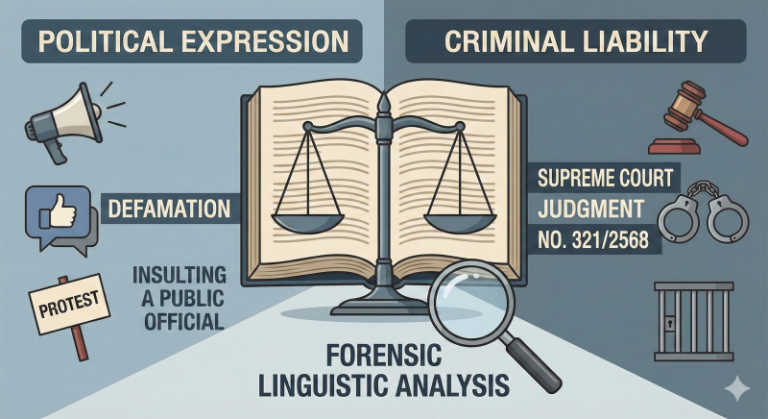
Political Expression and Criminal Liability for Defamation and Insulting a Public Official:
A Forensic Linguistic Analysis of Supreme Court Judgment No. 321/2568
Writer: Wanitcha Sumanat, president of the Southeast Asian Association of Professional Translators and Interpreters (SEAProTI) and Forensic Linguist and Legal Translator/Interpreter
18 February 2026, Bangkok – This article analyzes Supreme Court Judgment No. 321/2568, which concerns the installation of large vinyl banners along a public roadside, accusing a provincial governor of benefiting capitalists and politicians in relation to national reserved forest land. The Supreme Court affirmed the judgment of the Court of Appeal Region 6, holding that such conduct constituted the offense of insulting a public official under Section 136 of the Thai Criminal Code and defamation by publication under Section 328. The Court further held that the conduct did not fall within the exemptions provided under Section 329 (1) and (3).
This article employs a forensic linguistic framework to examine the interpretation of language, communicative intent, and contextual dissemination, while discussing the boundary between freedom of political expression and imputations that give rise to both criminal and civil liability.
Keywords: defamation, insulting a public official, forensic linguistics, publication, freedom of expression
1. Introduction
The expression of opinions concerning public officials is a cornerstone of democratic governance. However, such freedom is not absolute. Where expression causes reputational harm without a factual foundation, it may constitute criminal defamation.
Supreme Court Judgment No. 321/2568 presents a significant case study reflecting the tension between freedom of political expression and the legal protection of a public official’s reputation, particularly where communication occurs in a public space and is disseminated widely.
2. Facts and Legal Issues
The defendant installed two large vinyl banners along the Phitsanulok–Lom Sak highway, a public roadway with substantial traffic. The banners displayed the image of the Governor of Phetchabun Province and included statements alleging that he benefited capitalists and politicians by converting national reserved forest land into state property (ราชพัสดุ), thereby assisting forest encroachers in retaining land without legal consequences.
The principal legal issues were:
- Whether the conduct constituted insulting a public official under Section 136 of the Criminal Code.
- Whether it amounted to defamation by publication under Section 328;
- Whether the conduct fell within the exemptions under Section 329 (1) and (3); and
- The extent of the defendant’s civil liability for damages.
3. The Supreme Court’s Ruling
The Supreme Court held that the content of the banners led the public to understand that the Governor had facilitated unlawful conduct, thereby damaging his honor and reputation.
The installation of large banners in a public area constituted dissemination to a broad audience and therefore qualified as “publication” under Section 328.
The Court further held that the conduct did not fall within the exemption under Section 329, as it was not made in good faith. If the defendant believed the Governor’s actions were unlawful, legal remedies should have been pursued through judicial channels.
In the civil aspect, the Court found the conduct to constitute a tort causing reputational damage and ordered the defendant to pay 500,000 baht in damages with interest, while suspending the custodial sentence.
4. Forensic Linguistic Analysis
4.1 Contextual Interpretation
Forensic linguistics emphasizes the role of context in interpreting meaning (Coulthard & Johnson, 2010). In this case, the Court did not analyze the wording in isolation but considered the location and size of the banners, which reflected an intention to communicate broadly to the public.
This contextual factor transformed the message from a policy critique into an accusatory assertion.
4.2 Communicative Intent
From a pragmatic perspective, meaning derives not only from linguistic form but from speaker intention and audience interpretation (Tiersma, 1999).
The statement that the governor “helped politicians who encroached upon forest land retain possession without violating the law” constitutes an assertion of fact rather than a mere opinion.
Accordingly, the Court interpreted the statement as an imputation, satisfying the elements of defamation.
4.3 The Boundary Between Opinion and Imputation
Section 329 of the Criminal Code provides exemptions for good-faith criticism. However, such an exemption requires:
- Good faith;
- Factual foundation; and
- Public interest justification.
In this case, the Court found that the language used amounted to an allegation of unlawful conduct without evidentiary support, exceeding the permissible scope of criticism.
4.4 Civil Liability
Defamation resulting in reputational harm constitutes a tort under Section 420 of the Civil and Commercial Code. The assessment of damages falls within judicial discretion under Section 438.
The Court awarded 500,000 baht in damages, taking into account the plaintiff’s status and the seriousness of the harm.
5. Discussion
This judgment reinforces the principle that criticism of public officials is permissible but must be grounded in fact and expressed in good faith.
From a forensic linguistic perspective, the case illustrates the court’s reliance on pragmatic elements and contextual dissemination in determining communicative intent. The decision underscores that public display, audience scope, and linguistic framing collectively shape legal interpretation.
6. Conclusion
Supreme Court Judgment No. 321/2568 establishes an important precedent concerning public political expression through mass display. The Court held that the installation of large banners in a public space containing unsupported allegations of unlawful assistance by a public official constituted both insulting a public official and defamation by publication and did not qualify for exemption under Section 329.
The case thus serves as a significant reference point in Thai forensic linguistics and public communication law.
References
- Coulthard, M., & Johnson, A. (2010). An introduction to forensic linguistics: Language in evidence (2nd ed.). Routledge.
- Tiersma, P. M. (1999). Legal language. University of Chicago Press.
- Thai Criminal Code.
- Thai Civil and Commercial Code.
- Supreme Court Judgment No. 321/2568.
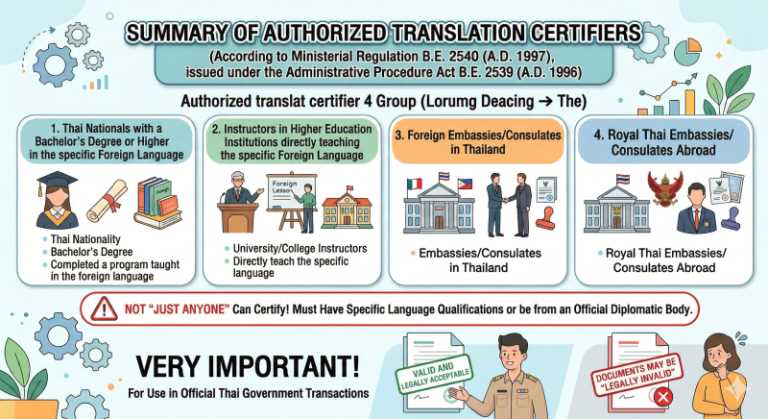
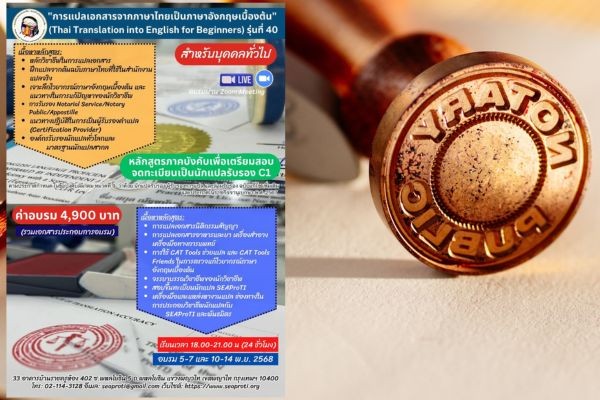
This section provides information about certified translators, translation certifiers, and certified interpreters associated with SEAProTI.
The Southeast Asian Association of Professional Translators and Interpreters (SEAProTI) has officially shared the qualifications and requirements for becoming Certified Translators, Translation Certification Providers, and Certified Interpreters in Sections 9 and 10 of the Royal Gazette, which was published by the Prime Minister’s Office in Thailand on July 25, 2024. Certified Translators, Translation Certification Providers, and Certified Interpreters
The Council of State has proposed the enactment of a Royal Decree, granting registered translators and recognised translation certifiers from professional associations or accredited language institutions the authority to provide legally valid translation certification (Letter to SEAProTI dated April 28, 2025)
SEAProTI is the first professional association in Thailand and Southeast Asia to implement a comprehensive certification system for translators, certifiers, and interpreters.
Head Office: Baan Ratchakru Building, No. 33, Room 402, Soi Phahonyothin 5, Phahonyothin Road, Phaya Thai District, Bangkok 10400, Thailand
Email: hello@seaproti.com | Tel.: (+66) 2-114-3128 (Office hours: Mon–Fri, 09:00–17:00)
การแสดงความคิดเห็นทางการเมืองกับความรับผิดฐานหมิ่นประมาทและดูหมิ่นเจ้าพนักงาน:
วิเคราะห์คำพิพากษาศาลฎีกาที่ 321/2568 ด้วยกรอบนิติภาษาศาสตร์
ผู้แต่ง วณิชชา สุมานัส นักนิติภาษาศาสตร์ และผู้ปฏิบัติงานด้านการแปลและล่ามในกระบวนการยุติธรรม
18 กุมภาพันธ์ 2569, กรุงเทพมหานคร – บทความนี้วิเคราะห์คำพิพากษาศาลฎีกาที่ 321/2568 ซึ่งวินิจฉัยกรณีการติดตั้งแผ่นป้ายไวนิลขนาดใหญ่ริมถนนสาธารณะ กล่าวหาผู้ว่าราชการจังหวัดว่าเอื้อประโยชน์ให้นายทุนและนักการเมืองในประเด็นป่าสงวนแห่งชาติ ศาลฎีกายืนตามศาลอุทธรณ์ภาค 6 ว่าการกระทำดังกล่าวเป็นความผิดฐานดูหมิ่นเจ้าพนักงานตามประมวลกฎหมายอาญา มาตรา 136 และหมิ่นประมาทโดยการโฆษณาตามมาตรา 328 และไม่เข้าข้อยกเว้นตามมาตรา 329 (1), (3) บทความนี้ใช้กรอบวิเคราะห์เชิงนิติภาษาศาสตร์ (forensic linguistics) เพื่ออธิบายการตีความถ้อยคำ เจตนาการสื่อสาร และบริบทการเผยแพร่ พร้อมอภิปรายเส้นแบ่งระหว่างเสรีภาพในการแสดงความคิดเห็นกับการใส่ความที่ก่อให้เกิดความรับผิดทางอาญาและทางแพ่ง
คำสำคัญ: หมิ่นประมาท, ดูหมิ่นเจ้าพนักงาน, นิติภาษาศาสตร์, การโฆษณา, เสรีภาพในการแสดงความคิดเห็น
1. บทนำ
การแสดงความคิดเห็นต่อเจ้าหน้าที่รัฐเป็นหัวใจสำคัญของระบอบประชาธิปไตย อย่างไรก็ดี เสรีภาพดังกล่าวมิใช่สิทธิที่ปราศจากขอบเขต หากการแสดงออกนั้นก่อให้เกิดความเสียหายต่อชื่อเสียงของบุคคลโดยปราศจากข้อเท็จจริงรองรับ ย่อมอาจเข้าข่ายความผิดฐานหมิ่นประมาท
คำพิพากษาศาลฎีกาที่ 321/2568 เป็นกรณีศึกษาที่สะท้อนความตึงเครียดระหว่าง “เสรีภาพในการแสดงความคิดเห็น” กับ “การคุ้มครองชื่อเสียงของเจ้าพนักงาน” โดยเฉพาะเมื่อการสื่อสารเกิดขึ้นในพื้นที่สาธารณะและมีลักษณะเป็นการเผยแพร่ในวงกว้าง
2. ข้อเท็จจริงและประเด็นปัญหากฎหมาย
จำเลยติดตั้งป้ายไวนิลขนาดใหญ่ 2 ป้าย ริมถนนสายพิษณุโลก–หล่มสัก ซึ่งเป็นเส้นทางสาธารณะที่มีผู้สัญจรจำนวนมาก เนื้อหาป้ายมีภาพผู้ว่าราชการจังหวัดเพชรบูรณ์ พร้อมข้อความกล่าวหาว่าเอื้อประโยชน์ให้นายทุนและนักการเมือง โดยเปลี่ยนสถานะป่าสงวนแห่งชาติเป็นที่ราชพัสดุ เพื่อช่วยเหลือผู้บุกรุกป่าให้ถือครองที่ดินได้โดยไม่ผิดกฎหมาย
ประเด็นปัญหาสำคัญ ได้แก่
- การกระทำดังกล่าวเป็นความผิดฐานดูหมิ่นเจ้าพนักงานตามมาตรา 136 หรือไม่
- เข้าข่ายหมิ่นประมาทโดยการโฆษณาตามมาตรา 328 หรือไม่
- การกระทำอยู่ในขอบเขตข้อยกเว้นตามมาตรา 329 (1), (3) หรือไม่
- จำเลยต้องรับผิดชดใช้ค่าสินไหมทดแทนเพียงใด
3. การวินิจฉัยของศาลฎีกา
ศาลฎีกาวินิจฉัยว่า ข้อความในป้ายทำให้ประชาชนเข้าใจว่าโจทก์ร่วมเอื้อประโยชน์แก่ผู้กระทำผิดกฎหมาย เป็นการทำให้เสื่อมเสียเกียรติและชื่อเสียง การติดตั้งป้ายขนาดใหญ่ในที่สาธารณะเป็นการเผยแพร่ต่อบุคคลจำนวนมาก จึงเป็น “การโฆษณา” ตามมาตรา 328 การกระทำไม่เข้าข้อยกเว้นตามมาตรา 329 เพราะมิใช่การติชมโดยสุจริต หากจำเลยเห็นว่าการดำเนินการของเจ้าพนักงานไม่ชอบด้วยกฎหมาย ควรใช้กระบวนการยุติธรรม ในส่วนแพ่ง ศาลเห็นว่าการกระทำเป็นละเมิด ทำให้โจทก์ร่วมเสียหายต่อชื่อเสียง จึงให้ชดใช้ค่าเสียหาย 500,000 บาท พร้อมดอกเบี้ย โดยรอการลงโทษจำคุก
4. การวิเคราะห์เชิงนิติภาษาศาสตร์
4.1 การตีความความหมายตามบริบท (Contextual Interpretation)
นิติภาษาศาสตร์ให้ความสำคัญกับบริบทของการสื่อสาร (Coulthard & Johnson, 2010) ในคดีนี้ ศาลมิได้พิจารณาเฉพาะตัวบทถ้อยคำ แต่พิจารณา “สถานที่ติดตั้ง” และ “ขนาดของป้าย” ซึ่งสะท้อนเจตนาเผยแพร่ต่อสาธารณชน บริบทดังกล่าวทำให้ข้อความมีนัยเป็นการกล่าวหา มิใช่เพียงการตั้งคำถามเชิงนโยบาย
4.2 เจตนาการสื่อสาร (Communicative Intent)
ในทางภาษาศาสตร์เชิงปฏิบัติการ (pragmatics) ความหมายมิได้เกิดจากถ้อยคำล้วน ๆ แต่เกิดจากเจตนาผู้พูดและผลที่เกิดแก่ผู้รับสาร (Tiersma, 1999)
ข้อความที่ว่า “ช่วยให้นักการเมืองที่บุกรุกป่าถือครองได้โดยไม่ผิดกฎหมาย” มีลักษณะเป็นข้อกล่าวหาเชิงข้อเท็จจริง (assertion of fact) มิใช่เพียงความคิดเห็น (opinion)
ศาลจึงตีความว่าเป็นการ “ใส่ความ” ตามองค์ประกอบของความผิดฐานหมิ่นประมาท
4.3 เส้นแบ่งระหว่างความคิดเห็นกับการใส่ความ
หลักกฎหมายอาญามาตรา 329 วางข้อยกเว้นสำหรับการติชมโดยสุจริต อย่างไรก็ตาม การอ้างข้อยกเว้นดังกล่าวต้องแสดงให้เห็นว่า
- เป็นการแสดงความคิดเห็นโดยสุจริต
- มีข้อเท็จจริงรองรับ
- มีวัตถุประสงค์เพื่อประโยชน์สาธารณะ
ในคดีนี้ ศาลเห็นว่าการใช้ถ้อยคำในลักษณะกล่าวหาว่าช่วยเหลือผู้กระทำผิดกฎหมาย โดยไม่มีข้อเท็จจริงพิสูจน์ได้ เป็นการกล่าวหาที่เกินขอบเขตการวิพากษ์วิจารณ์
4.4 ความรับผิดทางแพ่ง
การหมิ่นประมาทที่ก่อให้เกิดความเสียหายต่อชื่อเสียงถือเป็นละเมิดตามประมวลกฎหมายแพ่งและพาณิชย์ มาตรา 420 และการกำหนดค่าสินไหมทดแทนอยู่ภายใต้ดุลพินิจศาลตามมาตรา 438
ศาลกำหนดค่าเสียหาย 500,000 บาท โดยพิจารณาจากสถานะของผู้เสียหายและความร้ายแรงแห่งละเมิด
5. ข้ออภิปราย
คำพิพากษานี้ตอกย้ำหลักสำคัญว่าการวิพากษ์วิจารณ์เจ้าพนักงานทำได้ แต่ต้องอยู่บนพื้นฐานของข้อเท็จจริง และต้องไม่เป็นการใส่ความให้เสื่อมเสียชื่อเสียง
ในมิติของนิติภาษาศาสตร์ คดีนี้แสดงให้เห็นว่าศาลให้ความสำคัญกับ “องค์ประกอบเชิงวัจนปฏิบัติ” (pragmatic elements) และ “บริบทการเผยแพร่” ในการวินิจฉัยเจตนา
6. บทสรุป
คำพิพากษาศาลฎีกาที่ 321/2568 เป็นบรรทัดฐานสำคัญเกี่ยวกับการใช้สื่อสาธารณะในการแสดงความคิดเห็นทางการเมือง ศาลวินิจฉัยว่า การติดตั้งป้ายขนาดใหญ่ในที่สาธารณะ พร้อมข้อความกล่าวหาว่าเจ้าพนักงานเอื้อประโยชน์แก่ผู้กระทำผิดกฎหมาย โดยข้อเท็จจริงไม่รองรับ เป็นทั้งความผิดฐานดูหมิ่นเจ้าพนักงานและหมิ่นประมาทโดยการโฆษณา และไม่เข้าข้อยกเว้นตามมาตรา 329
คดีนี้จึงเป็นกรณีศึกษาที่สำคัญในทางนิติภาษาศาสตร์และกฎหมายสื่อสารสาธารณะของไทย
เอกสารอ้างอิง (References)
- Coulthard, M., & Johnson, A. (2010). An introduction to forensic linguistics: Language in evidence (2nd ed.). Routledge.
- Tiersma, P. M. (1999). Legal language. University of Chicago Press.
- ประมวลกฎหมายอาญา.
- ประมวลกฎหมายแพ่งและพาณิชย์.
- คำพิพากษาศาลฎีกาที่ 321/2568.
สมาคมวิชาชีพนักแปลและล่ามแห่งเอเชียตะวันออกเฉียงใต้ (SEAProTI) ได้ประกาศหลักเกณฑ์และคุณสมบัติของผู้ที่ขึ้นทะเบียนเป็น “นักแปลรับรอง (Certified Translators) และผู้รับรองการแปล (Translation Certification Providers) และล่ามรับรอง (Certified Interpreters)” ของสมาคม หมวดที่ 9 และหมวดที่ 10 ในราชกิจจานุเบกษา ของสำนักเลขาธิการคณะรัฐมนตรี ในสำนักนายกรัฐมนตรี แห่งราชอาณาจักรไทย ลงวันที่ 25 ก.ค. 2567 เล่มที่ 141 ตอนที่ 66 ง หน้า 100 อ่านฉบับเต็มได้ที่: นักแปลรับรอง ผู้รับรองการแปล และล่ามรับรอง
สำนักคณะกรรมการกฤษฎีกาเสนอให้ตราเป็นพระราชกฤษฎีกา โดยกำหนดให้นักแปลที่ขึ้นทะเบียน รวมถึงผู้รับรองการแปลจากสมาคมวิชาชีพหรือสถาบันสอนภาษาที่มีการอบรมและขึ้นทะเบียน สามารถรับรองคำแปลได้ (จดหมายถึงสมาคม SEAProTI ลงวันที่ 28 เม.ย. 2568)
สมาคมวิชาชีพนักแปลและล่ามแห่งเอเชียตะวันออกเฉียงใต้เป็นสมาคมวิชาชีพแห่งแรกและแห่งเดียวในประเทศไทยและภูมิภาคเอเชียตะวันออกเฉียงใต้ที่มีระบบรับรองนักแปลรับรอง ผู้รับรองการแปล และล่ามรับรอง
สำนักงานใหญ่: อาคารบ้านราชครู เลขที่ 33 ห้อง 402 ซอยพหลโยธิน 5 ถนนพหลโยธิน แขวงพญาไท เขตพญาไท กรุงเทพมหานคร 10400 ประเทศไทย
อีเมล: hello@seaproti.com โทรศัพท์: (+66) 2-114-3128 (เวลาทำการ: วันจันทร์–วันศุกร์ เวลา 09.00–17.00 น.