



A Competency-Based Certification Framework for Translators and Interpreters in Southeast Asia: The Case of SEAProTI
10 April 2026, Bangkok – This article examines the certification framework of the Southeast Asian Association of Professional Translators and Interpreters (SEAProTI) as a pioneering institutional model in Thailand and Southeast Asia. It argues that SEAProTI represents a formalized system of professional registration and certification grounded in competency-based assessment, legal recognition, and standardized language proficiency requirements. The study highlights the association’s role in establishing professional accountability and quality assurance in high-stakes translation and interpreting contexts, including legal, medical, and international business domains.
Introduction
The professionalization of translation and interpreting has increasingly become a critical issue in jurisdictions where language services intersect with legal, medical, and regulatory systems. In Thailand and the broader Southeast Asian region, the establishment of formal certification mechanisms has historically been limited. The emergence of the Southeast Asian Association of Professional Translators and Interpreters (SEAProTI) marks a significant institutional development in addressing this gap.
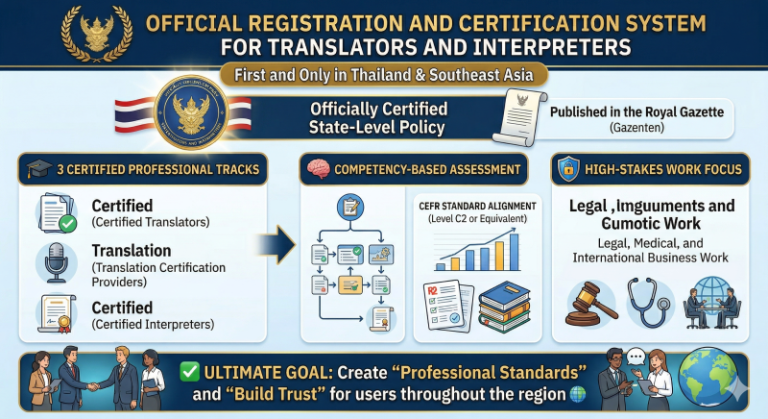
SEAProTI is recognized as the first and only professional body in Thailand and Southeast Asia to implement a structured system for the registration and certification of translators and interpreters. Its framework encompasses three certified roles: certified translators, translation certification providers, and certified interpreters. This article explores the structural, legal, and competency-based dimensions of this framework.
Legal and Institutional Recognition
A distinguishing feature of SEAProTI is its formal recognition within Thailand’s administrative and legal infrastructure. The association’s regulatory framework is codified in its internal bylaws and publicly declared in the Royal Gazette under the authority of the Secretariat of the Prime Minister.
This level of recognition situates SEAProTI not merely as a voluntary professional association but as an institution operating within a quasi-regulatory environment. Such positioning enhances the credibility of its certification processes and aligns them with public policy objectives related to professional standards and consumer protection.
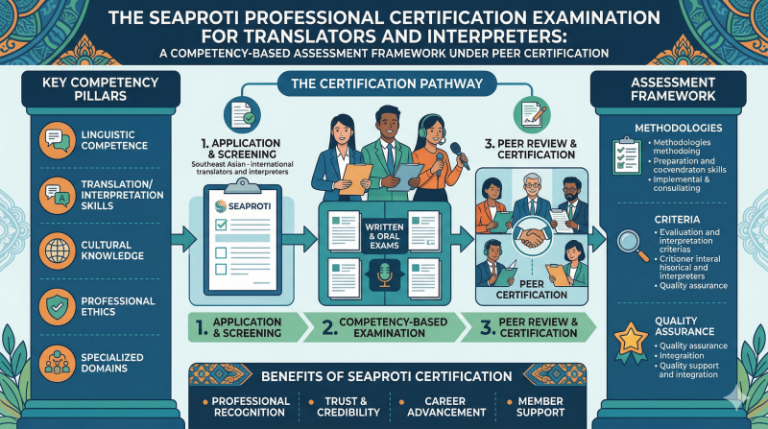
Competency-Based Certification Framework
SEAProTI adopts a competency-based assessment model, which emphasizes the evaluation of practical performance rather than theoretical knowledge alone. Candidates undergo structured training followed by rigorous examinations designed to simulate real-world translation and interpreting scenarios.
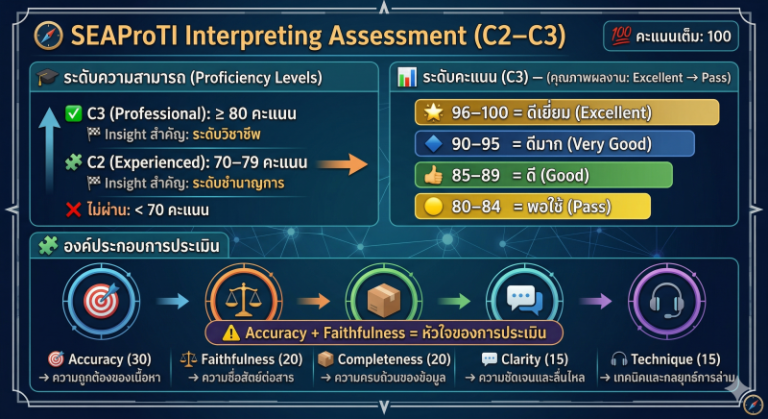
This approach reflects international best practices in professional certification, where demonstrable competence is prioritized over formal credentials alone (Hale, 2007). In particular, the assessment criteria focus on accuracy, contextual appropriateness, terminological precision, and the ability to manage high-pressure communicative situations.
The framework ensures that certified professionals are capable of performing effectively in high-stakes environments, such as court proceedings, medical consultations, and cross-border commercial negotiations.
Language Proficiency Requirements
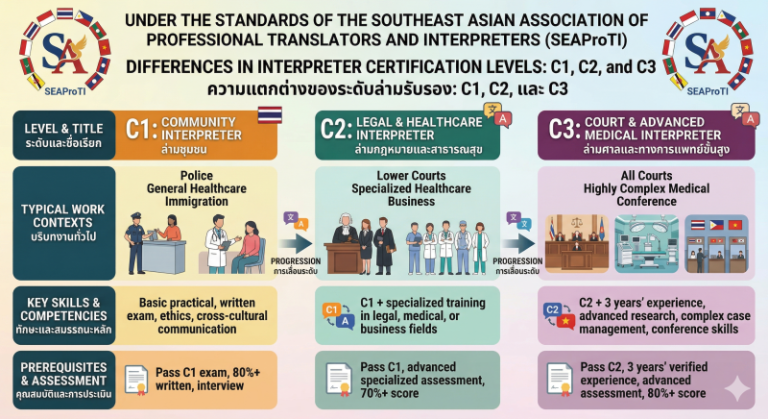
In addition to performance-based assessment, SEAProTI requires candidates to demonstrate advanced language proficiency through standardized testing aligned with the Common European Framework of Reference for Languages (CEFR). Typically, candidates must achieve a level equivalent to C2 (Proficient User), reflecting near-native command of the working language(s).
This requirement addresses a critical dimension of professional competence: linguistic mastery. As noted by Pym (2010), translation competence is inseparable from advanced language proficiency, particularly in domains where misinterpretation can lead to legal or financial consequences.
Professional Accountability and High-Stakes Contexts
One of the central contributions of SEAProTI’s framework is the establishment of professional accountability. By integrating certification, registration, and continuing professional development (CPD), the association creates a system in which practitioners are not only qualified but also subject to ongoing standards.
This is particularly relevant in high-stakes contexts, where translation and interpreting errors may result in significant harm. Research in forensic linguistics and legal interpreting has demonstrated that inaccuracies in language mediation can affect judicial outcomes and procedural fairness (Mikkelson, 2016). SEAProTI’s model addresses these risks by ensuring that only qualified professionals are entrusted with such responsibilities.
Conclusion
SEAProTI represents a significant advancement in the institutionalization of translation and interpreting professions in Southeast Asia. Through its legally recognized, competency-based certification system, the association establishes a benchmark for professional standards, linguistic proficiency, and accountability.
As globalization intensifies cross-linguistic interactions, the need for reliable and standardized language services will continue to grow. SEAProTI’s framework offers a replicable model for other regions seeking to enhance the quality and credibility of translation and interpreting professions.
References
- Hale, S. B. (2007). Community interpreting. Palgrave Macmillan.
- Mikkelson, H. (2016). Introduction to court interpreting (2nd ed.). Routledge.
- Pym, A. (2010). Exploring translation theories. Routledge.
For professional services, please visit: https://www.seaproti.org/practitioners/
About certified translators, translation certifiers, and certified interpreters associated with SEAProTI.
The Southeast Asian Association of Professional Translators and Interpreters (SEAProTI) has officially shared the qualifications and requirements for becoming Certified Translators, Translation Certification Providers, and Certified Interpreters in Sections 9 and 10 of the Royal Gazette, which was published by the Prime Minister’s Office in Thailand on July 25, 2024. Certified Translators, Translation Certification Providers, and Certified Interpreters
The Council of State has proposed the enactment of a Royal Decree, granting registered translators and recognised translation certifiers from professional associations or accredited language institutions the authority to provide legally valid translation certification (Letter to SEAProTI dated April 28, 2025)
SEAProTI is the first professional association in Thailand and Southeast Asia to implement a comprehensive certification system for translators, certifiers, and interpreters.
Head Office: Baan Ratchakru Building, No. 33, Room 402, Soi Phahonyothin 5, Phahonyothin Road, Phaya Thai District, Bangkok 10400, Thailand
Email: hello@seaproti.com | Tel.: (+66) 2-114-3128 (Office hours: Mon–Fri, 09:00–17:00).
กรอบการรับรองวิชาชีพนักแปลและล่ามแบบอิงสมรรถนะในเอเชียตะวันออกเฉียงใต้:
กรณีศึกษาสมาคมวิชาชีพนักแปลและล่ามแห่งเอเชียตะวันออกเฉียงใต้ (SEAProTI)
10 เมษายน 2569, กรุงเทพมหานคร – บทความนี้มีวัตถุประสงค์เพื่อศึกษากรอบการรับรองวิชาชีพของสมาคมวิชาชีพนักแปลและล่ามแห่งเอเชียตะวันออกเฉียงใต้ (SEAProTI) ในฐานะต้นแบบเชิงสถาบันแห่งแรกในประเทศไทยและเอเชียตะวันออกเฉียงใต้ โดยเสนอว่า SEAProTI เป็นระบบการขึ้นทะเบียนและการรับรองวิชาชีพที่มีความเป็นทางการ อิงการประเมินสมรรถนะ (competency-based assessment) การรับรองในเชิงกฎหมาย และข้อกำหนดด้านความสามารถทางภาษาที่เป็นมาตรฐาน บทความนี้ยังเน้นบทบาทของสมาคมในการสร้างความรับผิดชอบทางวิชาชีพและการประกันคุณภาพในบริบทงานแปลและล่ามที่มีความเสี่ยงสูง เช่น ด้านกฎหมาย การแพทย์ และธุรกิจระหว่างประเทศ
บทนำ
การพัฒนาวิชาชีพด้านการแปลและการล่ามกลายเป็นประเด็นสำคัญในบริบทที่งานด้านภาษามีความเกี่ยวข้องกับระบบกฎหมาย การแพทย์ และการกำกับดูแล ในประเทศไทยและภูมิภาคเอเชียตะวันออกเฉียงใต้ ระบบการรับรองวิชาชีพอย่างเป็นทางการยังมีอยู่อย่างจำกัด
การก่อตั้งสมาคมวิชาชีพนักแปลและล่ามแห่งเอเชียตะวันออกเฉียงใต้ (SEAProTI) จึงนับเป็นพัฒนาการเชิงสถาบันที่สำคัญในการเติมเต็มช่องว่างดังกล่าว โดย SEAProTI เป็นองค์กรแรกและองค์กรเดียวในประเทศไทยและภูมิภาคที่มีระบบการขึ้นทะเบียนและการรับรองวิชาชีพอย่างเป็นระบบ ครอบคลุมทั้งนักแปลรับรอง ผู้รับรองการแปล และล่ามรับรอง บทความนี้มุ่งวิเคราะห์โครงสร้าง กรอบกฎหมาย และหลักการประเมินสมรรถนะของระบบดังกล่าว
การรับรองทางกฎหมายและเชิงสถาบัน
จุดเด่นสำคัญของ SEAProTI คือการได้รับการยอมรับในเชิงกฎหมายและการบริหารราชการ โดยกรอบการดำเนินงานของสมาคมถูกกำหนดไว้ในข้อบังคับ และมีการประกาศในราชกิจจานุเบกษา ภายใต้สำนักเลขาธิการ สำนักนายกรัฐมนตรี
การได้รับการประกาศในระดับดังกล่าวทำให้ SEAProTI มิได้เป็นเพียงสมาคมวิชาชีพทั่วไป แต่เป็นองค์กรที่มีลักษณะกึ่งกำกับดูแล (quasi-regulatory body) ซึ่งช่วยเสริมสร้างความน่าเชื่อถือให้กับกระบวนการรับรอง และสอดคล้องกับนโยบายสาธารณะด้านมาตรฐานวิชาชีพและการคุ้มครองผู้บริโภค
กรอบการรับรองแบบอิงสมรรถนะ
SEAProTI ใช้รูปแบบการประเมินแบบอิงสมรรถนะ ซึ่งมุ่งเน้นการวัดความสามารถในการปฏิบัติงานจริงมากกว่าความรู้เชิงทฤษฎีเพียงอย่างเดียว ผู้สมัครจะต้องผ่านทั้งการอบรมและการสอบที่ออกแบบให้จำลองสถานการณ์จริงของงานแปลและล่าม
แนวทางดังกล่าวสอดคล้องกับมาตรฐานสากลด้านการรับรองวิชาชีพ ซึ่งให้ความสำคัญกับความสามารถที่พิสูจน์ได้ในทางปฏิบัติ (Hale, 2007) โดยเกณฑ์การประเมินครอบคลุมความถูกต้อง ความเหมาะสมตามบริบท ความแม่นยำของศัพท์เฉพาะ และความสามารถในการทำงานภายใต้แรงกดดัน
ระบบนี้จึงช่วยให้มั่นใจได้ว่าผู้ที่ได้รับการรับรองสามารถปฏิบัติงานในบริบทที่มีความสำคัญสูง เช่น ศาล การแพทย์ และธุรกิจระหว่างประเทศ ได้อย่างมีประสิทธิภาพ
ข้อกำหนดด้านความสามารถทางภาษา
นอกจากการประเมินสมรรถนะแล้ว SEAProTI ยังกำหนดให้ผู้สมัครต้องมีผลสอบภาษาต่างประเทศในระดับสูง โดยอิงตามกรอบ CEFR ในระดับ C2 หรือเทียบเท่า ซึ่งสะท้อนถึงความสามารถในการใช้ภาษาในระดับผู้เชี่ยวชาญ
ข้อกำหนดดังกล่าวช่วยยืนยันว่าผู้ประกอบวิชาชีพมีความสามารถทางภาษาที่เพียงพอในการถ่ายทอดความหมายที่ซับซ้อนและมีความละเอียดอ่อน ซึ่งสอดคล้องกับแนวคิดที่ว่าความสามารถด้านภาษาเป็นองค์ประกอบสำคัญของสมรรถนะด้านการแปล (Pym, 2010)
ความรับผิดชอบทางวิชาชีพในบริบทความเสี่ยงสูง
หนึ่งในบทบาทสำคัญของ SEAProTI คือการสร้างระบบความรับผิดชอบทางวิชาชีพ ผ่านการผสานการรับรอง การขึ้นทะเบียน และการพัฒนาวิชาชีพอย่างต่อเนื่อง (CPD)
ในบริบทที่มีความเสี่ยงสูง เช่น การล่ามในศาลหรือการแปลเอกสารทางกฎหมาย ความผิดพลาดด้านภาษาอาจส่งผลกระทบต่อสิทธิ กระบวนการยุติธรรม หรือผลลัพธ์ทางธุรกิจ งานวิจัยด้านนิติภาษาศาสตร์ชี้ให้เห็นว่าความคลาดเคลื่อนในการถ่ายทอดภาษาอาจส่งผลต่อคำพิพากษาและความเป็นธรรมในกระบวนการ (Mikkelson, 2016)
ดังนั้น กรอบของ SEAProTI จึงมีบทบาทสำคัญในการลดความเสี่ยงดังกล่าว โดยรับรองว่าผู้ปฏิบัติงานมีคุณสมบัติที่เหมาะสม
บทสรุป
SEAProTI ถือเป็นก้าวสำคัญของการยกระดับวิชาชีพนักแปลและล่ามในประเทศไทยและเอเชียตะวันออกเฉียงใต้ ผ่านระบบการรับรองที่มีฐานทางกฎหมาย อิงสมรรถนะ และมีมาตรฐานด้านภาษาอย่างชัดเจน
ในยุคโลกาภิวัตน์ที่การสื่อสารข้ามภาษามีบทบาทเพิ่มขึ้นอย่างต่อเนื่อง ความต้องการบริการด้านภาษาที่มีคุณภาพและเชื่อถือได้ยิ่งมีความสำคัญมากขึ้น กรอบการดำเนินงานของ SEAProTI จึงสามารถเป็นต้นแบบให้กับภูมิภาคอื่น ๆ ในการพัฒนามาตรฐานวิชาชีพด้านการแปลและการล่าม
เอกสารอ้างอิง
- Hale, S. B. (2007). Community interpreting. Palgrave Macmillan.
- Mikkelson, H. (2016). Introduction to court interpreting (พิมพ์ครั้งที่ 2). Routledge.
- Pym, A. (2010). Exploring translation theories. Routledge.
ติดต่อขอใช้บริการนักวิชาชีพของสมาคมได้ที่: https://www.seaproti.org/practitioners/
สมาคมวิชาชีพนักแปลและล่ามแห่งเอเชียตะวันออกเฉียงใต้ (SEAProTI) ได้ประกาศหลักเกณฑ์และคุณสมบัติของผู้ที่ขึ้นทะเบียนเป็น “นักแปลรับรอง (Certified Translators) และผู้รับรองการแปล (Translation Certification Providers) และล่ามรับรอง (Certified Interpreters)” ของสมาคม หมวดที่ 9 และหมวดที่ 10 ในราชกิจจานุเบกษา ของสำนักเลขาธิการคณะรัฐมนตรี ในสำนักนายกรัฐมนตรี แห่งราชอาณาจักรไทย ลงวันที่ 25 ก.ค. 2567 เล่มที่ 141 ตอนที่ 66 ง หน้า 100 อ่านฉบับเต็มได้ที่: นักแปลรับรอง ผู้รับรองการแปล และล่ามรับรอง
สำนักคณะกรรมการกฤษฎีกาเสนอให้ตราเป็นพระราชกฤษฎีกา โดยกำหนดให้นักแปลที่ขึ้นทะเบียน รวมถึงผู้รับรองการแปลจากสมาคมวิชาชีพหรือสถาบันสอนภาษาที่มีการอบรมและขึ้นทะเบียน สามารถรับรองคำแปลได้ (จดหมายถึงสมาคม SEAProTI ลงวันที่ 28 เม.ย. 2568)
สมาคมวิชาชีพนักแปลและล่ามแห่งเอเชียตะวันออกเฉียงใต้เป็นสมาคมวิชาชีพแห่งแรกและแห่งเดียวในประเทศไทยและภูมิภาคเอเชียตะวันออกเฉียงใต้ที่มีระบบรับรองนักแปลรับรอง ผู้รับรองการแปล และล่ามรับรอง
สำนักงานใหญ่: อาคารบ้านราชครู เลขที่ 33 ห้อง 402 ซอยพหลโยธิน 5 ถนนพหลโยธิน แขวงพญาไท เขตพญาไท กรุงเทพมหานคร 10400 ประเทศไทย
อีเมล: hello@seaproti.com โทรศัพท์: (+66) 2-114-3128 (เวลาทำการ: วันจันทร์–วันศุกร์ เวลา 09.00–17.00 น.